

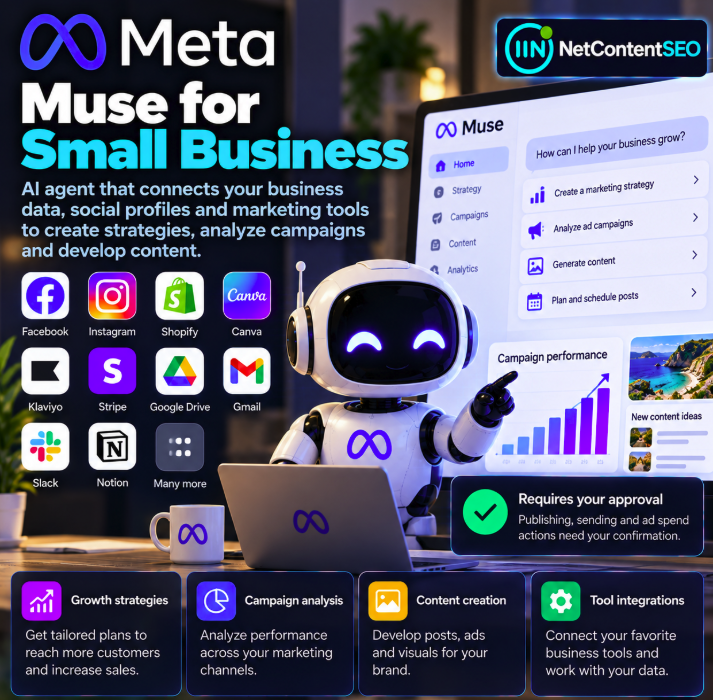

Meta is positioning Muse for Small Business as an AI marketing agent that can work with connected business data and tools to develop growth strategies, analyze campaigns and prepare content. Its official announcement, originally published September 29, 2026 and updated October 8, describes integrations spanning Meta's social platforms and third-party commerce and marketing services, including Facebook, Instagram, Shopify, Canva, Klaviyo and Stripe.
The important distinction is between preparing a recommended action and executing it. Meta says consequential actions such as publishing, sending messages or spending money require user approval. Availability is limited to supported markets and may depend on individual account eligibility and connected services.
Primary source: Meta — Introducing Muse for Small Business.
What is Muse for Small Business?
Muse for Small Business is presented as an AI agent for entrepreneurs and smaller organizations that need help turning business information into practical marketing work. Rather than only generating standalone text, it can use information from connected accounts and services to assist with strategic planning, campaign analysis and content development.
That makes it an example of a broader change in AI products: the assistant becomes a layer across existing applications, rather than a separate text box disconnected from the tools a business already uses.
Which services can Muse connect to?
Meta's announcement lists a range of marketing, creative and commerce integrations. The services highlighted in the October update include:
| Service | Role in a small-business workflow |
|---|---|
| Social presence and business marketing context | |
| Social content and audience-facing activity | |
| Shopify | Commerce and store-related context |
| Canva | Creative content and design workflows |
| Klaviyo | Email and customer-marketing workflows |
| Stripe | Payment-related business context |
The presence of a service in a product's integration list does not guarantee that every possible operation in that service is supported. Users should review the permissions, available actions and account-specific setup before relying on a particular workflow.
From disconnected dashboards to cross-tool marketing workflows
Small businesses often work across several platforms: a social account for customer communication, a storefront for sales, a creative tool for visuals and an email platform for follow-up campaigns. Pulling information together manually can be time-consuming.
An agent that can access authorized data across these tools may help a business identify opportunities, summarize performance and draft next steps. For example, it could assist with preparing a campaign plan informed by the context available from connected marketing services. That is an illustrative use case, not a guarantee that Muse exposes every metric or can perform every cross-platform operation.
Growth strategies and campaign analysis
Meta describes Muse as able to help prepare growth strategies and analyze campaigns. For a small business, useful outputs might include suggestions about marketing priorities, campaign performance questions, content themes and potential experiments.
However, AI-generated recommendations should be checked against real account data, business constraints and measurement quality. A strategy draft is not evidence that a campaign will improve sales, and an automated summary may omit context that a business owner considers important.
Content creation across social and marketing channels
Content development is another announced use case. By drawing on business context, an agent may be able to prepare drafts more closely aligned with the products, audience and brand positioning available through connected tools.
Drafting content is different from publishing it. Meta explicitly identifies publishing among the actions that require approval. Teams should therefore treat the agent as a supervised collaborator rather than an autonomous publisher with unrestricted authority.
Approval gates for publishing, sending and spending
Meta says actions involving publication, sending and expenditure require user approval. That is a key product design detail because these operations can have real external consequences: a post becomes public, a message reaches a customer or advertising spend is committed.
An approval step helps keep a person in control of those decisions. It should not be interpreted as a guarantee that every draft is accurate, every suggested spend is commercially sensible or every connected application has identical permissions. Users still need to verify what they are approving.
Why the connector layer matters
The strategic development is not merely the addition of more integrations. Connecting social profiles, creative tools, commerce systems and marketing services can make an AI agent useful in a sequence of work rather than in isolated tasks.
For example, an organization may want to review a campaign, identify a content opportunity, draft a creative asset and prepare a follow-up communication. An agent with appropriately authorized connections can help coordinate parts of that process. Whether a specific end-to-end sequence is supported depends on the product's current capabilities and permissions.
What this means for SEO and AI visibility
For SEO and GEO professionals, Muse is primarily a marketing operations development, not an announced search-ranking change. It illustrates how businesses may increasingly use agents to organize content, compare campaign signals and prepare distribution across channels.
That could make brand consistency, accurate business information and reliable content review more important in day-to-day operations. Yet the launch does not establish that using Muse improves Google rankings, increases AI citations or changes how Facebook, Instagram or other platforms rank content.
AI visibility teams should distinguish three layers: information available to the agent through authorized integrations, actions the agent can prepare, and external results that can be measured after a person approves an action. Those are separate stages.
Privacy, permissions and account eligibility
Connecting business services requires careful attention to access permissions. Before enabling an integration, users should understand what information the agent can read, what operations it can propose or execute and how access can be managed.
Meta says Muse for Small Business is available in supported markets. That does not mean every business worldwide has immediate access, or that all connectors are available in every account. Product availability, regional eligibility and service-specific authorization should be checked in the current interface.
How a small business can evaluate Muse responsibly
- Start with a narrow objective. Choose one task, such as analyzing an existing campaign or preparing a social content plan.
- Connect only necessary services. Review requested permissions rather than authorizing every integration by default.
- Verify the source data. Check whether recommendations reflect current, relevant business information.
- Review generated content. Confirm product details, brand tone, claims and links before publication.
- Inspect approval requests. Confirm recipients, destinations and spending amounts before authorizing actions.
- Measure outcomes independently. Compare actual performance with business goals rather than assuming that an AI-generated plan guarantees growth.
What the announcement does not establish
- It does not guarantee global availability across all countries and accounts.
- It does not mean every connector supports every possible API action.
- It does not permit unrestricted publishing, sending or spending without approval.
- It does not announce a new Google Search or Meta social-ranking factor.
- It does not prove that AI-generated marketing strategies outperform human-led alternatives.
FAQ
What is Meta Muse for Small Business?
An AI agent intended to help small businesses use connected data and tools for marketing strategy, campaign analysis and content creation.
Which integrations are mentioned?
The official update highlights Facebook, Instagram, Shopify, Canva, Klaviyo and Stripe, among other services.
Can Muse publish content or spend money without approval?
Meta says publishing, sending and spending actions require user approval.
Is Muse available everywhere?
No. Availability is described in terms of supported markets and may depend on account eligibility.
Does Muse improve SEO rankings or AI citations?
No direct ranking or citation effect is announced. Its described capabilities concern marketing workflows and connected business tools.
When was the official announcement published?
The page was published September 29, 2026 and updated October 8, 2026, according to the supplied editorial brief.
NetContentSEO analysis
Meta Muse represents the shift from AI as a content generator to AI as a supervised marketing execution layer. Connecting business data, social profiles and commerce tools may help smaller organizations coordinate work that previously required switching between several applications. The defining boundary is human approval for consequential actions. For SEO and AI visibility practitioners, this is an important change in marketing operations, but not evidence of a new search-ranking or citation mechanism.
Primary source: Meta — Introducing Muse for Small Business.