

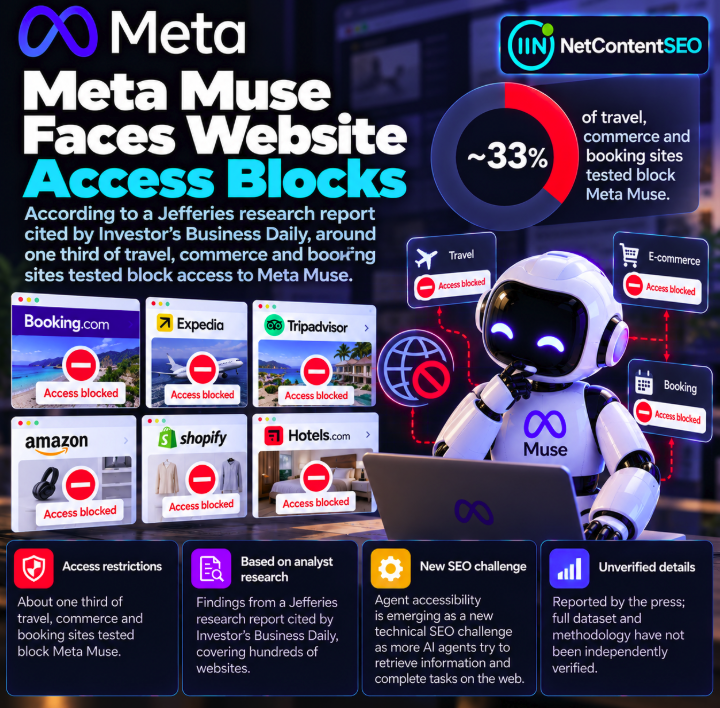

Roughly one-third of the travel, commerce and booking websites tested in a Jefferies research exercise reportedly restricted access to Meta Muse, according to an October 9, 2026 report by Investor's Business Daily. The analysis is said to cover hundreds of sites, raising a practical question for the emerging agentic web: can AI assistants reliably retrieve information and complete user tasks when websites restrict automated access?
These findings are analyst research reported by the press. The complete underlying dataset, testing methodology and definitions of a blocked attempt have not been independently verified for this article. The reported proportion applies to the tested sample, not to one-third of the entire web.
Reported source: Investor's Business Daily — Meta Muse Website Access Restrictions.
What the reported Jefferies research found
The report describes tests across hundreds of websites in travel, e-commerce and booking-related categories. Approximately one in three of the tested sites reportedly prevented the Muse agent from accessing or interacting with them in the tested conditions.
That headline number deserves scrutiny. Without the full methodology, we cannot establish how the websites were selected, which actions were attempted, how many retries occurred, whether authentication was involved, or whether all restrictions were caused by the same technical mechanism. It would be inaccurate to describe every failed attempt as a robots.txt block or as a deliberate policy against Meta specifically.
Why agent accessibility matters
AI agents differ from traditional search interfaces because they may attempt to complete multi-step tasks: identify an available service, compare options, retrieve up-to-date details, interact with forms or progress toward a booking. If an agent cannot access a relevant website, it may be unable to complete the workflow or verify the information needed for a reliable answer.
For travel and commerce businesses, that introduces a potential trade-off. Restricting automation can help address unwanted scraping, abuse or operational load, but it may also limit access for legitimate user-directed agents. The actual business impact depends on whether customers use those agents, which workflows are blocked and what alternatives remain available.
What does 'blocked' mean in practice?
Several different conditions can prevent an agent from completing a website task. A site may explicitly prohibit automated requests, use bot-detection challenges, require login, impose rate limits, depend on browser interactions that an agent cannot perform, or restrict access to specific endpoints. Some failures can also result from agent limitations rather than a deliberate website block.
The reported summary does not isolate these causes. Therefore, the safest interpretation is that the tested agent encountered access restrictions or failures at a substantial share of the sampled sites, not that every site intentionally blocked a known Meta Muse crawler.
Agent access is not identical to Google indexing
An agent failing to access a website does not automatically mean Googlebot cannot crawl it or that the website has been removed from Google Search. Different clients may use different request patterns, credentials, user agents, browser environments and permissions. Search indexing, AI-agent browsing and transactional automation are distinct technical activities.
A site could be indexed by Google yet still reject an automated booking attempt. Conversely, an agent might access public information without that information being eligible for conventional search indexing. SEO teams should measure each condition separately.
Why travel, booking and commerce are particularly relevant
These sectors often require real-time details such as availability, prices, product variants or booking conditions. An AI agent cannot reliably complete a task from stale information alone. It needs a trustworthy way to retrieve current facts and, where authorized, interact with the transaction flow.
That makes the reported access problem operational rather than merely cosmetic. A failed page visit may interrupt a comparison or purchase workflow. But the report does not establish a measured loss of bookings, revenue or conversions at any particular website.
How website owners can investigate agent accessibility
- Identify the exact agent and task. A general page fetch and an attempted booking are not the same test.
- Inspect access logs and responses. Look for relevant HTTP status codes, challenge pages, redirects and rate-limit responses.
- Review bot and firewall rules. Determine whether security tools are intentionally rejecting authorized automated clients.
- Test public information access. Check whether essential product, pricing and policy details can be retrieved consistently.
- Separate read access from actions. Viewing a listing and making a purchase require different safeguards and permissions.
- Protect user consent and security. Do not weaken anti-abuse controls merely to improve hypothetical agent compatibility.
- Document results over time. Record the test environment, agent version, request behavior and observed outcome.
Should businesses allow every AI agent?
No. There is no universal requirement to permit all automated clients, and open access is not inherently safer or better. Businesses must balance customer convenience with privacy, security, infrastructure cost, contractual restrictions and fraud prevention.
Where agent-mediated commerce is strategically important, a more deliberate approach may include clearly documented access rules, secure APIs, authenticated integrations and explicit authorization for consequential actions. These are potential design approaches, not capabilities established by the Jefferies report.
What this means for technical SEO and GEO
Traditional technical SEO examines whether search engines can discover, crawl, render and index pages. Agent accessibility adds another question: can a user-authorized AI assistant retrieve the necessary information and navigate a useful workflow?
This should not be confused with a confirmed ranking factor. No evidence in the reported findings establishes that Meta Muse accessibility changes Google rankings, AI Overview citations or other search visibility scores. It is an emerging operational dimension that may matter for businesses serving customers through AI agents.
Limitations of the reported study
The study is attributed to Jefferies and summarized by Investor's Business Daily. The complete dataset and testing protocol were not independently assessed here. As a result, this article does not name specific blocked websites, assign causes to individual failures, claim a statistically representative sample of the web or estimate a direct financial impact.
The phrase 'one-third of websites' must always be accompanied by 'tested' or equivalent wording to preserve the scope of the finding.
FAQ
How many sites reportedly blocked Meta Muse?
Approximately one-third of the travel, commerce and booking sites included in the reported Jefferies tests.
Was the sample the entire internet?
No. The report describes a sample of hundreds of websites in selected categories.
Do we know why every site blocked access?
No. The full methodology and individual causes were not independently verified.
Does a block against Muse mean a site is not indexed by Google?
No. Agent access and Google search indexing are separate systems and must be tested independently.
Does the report prove that sites lost sales?
No. It raises a potential obstacle to agent-assisted tasks but does not establish a measured revenue impact.
Is agent accessibility a Google ranking factor?
No such ranking factor is established by this research.
NetContentSEO analysis
The reported Meta Muse access failures highlight a new tension between automated customer assistance and website access controls. For technical SEO teams, the practical lesson is not to open every page to every bot. It is to distinguish search crawling from agent workflows, test access under defined conditions and make deliberate decisions about which user-authorized tasks a website should support. The Jefferies figure is a useful signal from a limited, not independently verified sample—not a definitive measurement of the entire web.
Reported source: Investor's Business Daily — Meta Muse Website Access Restrictions, October 9, 2026.