
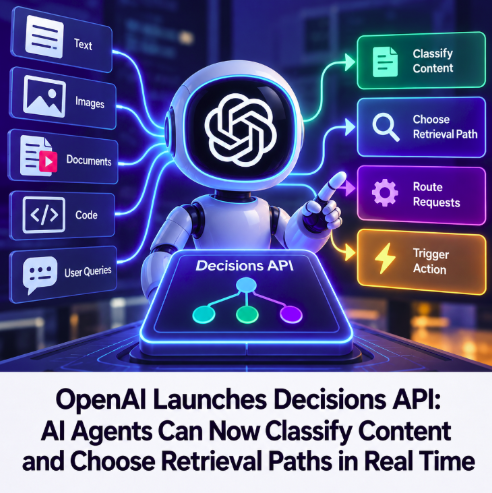
OpenAI has introduced the Decisions API, a new developer interface designed to turn model intelligence into structured, finite decisions that software can act on immediately.
Announced around OpenAI DevDay 2026, the API is currently in limited preview. OpenAI describes it as a way to use Luna for tasks such as classifying inputs, routing requests, or selecting an action from a predefined set of answers.
What the Decisions API does
Instead of asking a model to generate an open-ended response, developers can define a constrained decision space and ask the model to select the most appropriate result.
That makes the API particularly relevant for agentic systems where the next step must be deterministic enough to trigger software behavior.
- classifying incoming content or user requests;
- routing a query to the correct model, tool, database or workflow;
- choosing which retrieval source should be queried next;
- selecting the next action in an AI agent pipeline;
- mapping natural-language inputs to predefined business logic.
Why this matters for AI agents
The important shift is not simply another model endpoint. Decisions API gives developers a dedicated mechanism for turning model reasoning into a controlled branch inside an application.
For an AI agent, that can mean deciding whether to search the web, query an internal knowledge base, call a specialized tool, ask for more information, or execute a predefined workflow.
A new layer between prompts and retrieval
For search, SEO and AI visibility teams, one of the most interesting applications is retrieval routing.
An AI system can receive a question, classify its intent and then decide which retrieval path is most appropriate before generating an answer. For example, a system could route product questions to structured commerce data, current-event questions to web search, and brand-specific queries to an internal knowledge base.
This creates another decision layer between the user's prompt and the sources ultimately retrieved and cited.
Potential implications for AI visibility
For publishers and brands, this reinforces a broader trend: content needs to be understandable not only by ranking systems, but also by classification and orchestration layers that decide where an AI system should look before producing an answer.
Clear entity signals, topical focus, structured data, recognizable authorship and machine-readable content relationships may therefore become increasingly important as agentic retrieval architectures mature.
Availability
The Decisions API is currently available in limited preview. OpenAI's DevDay 2026 materials describe it as using Luna to classify inputs, route requests or choose an action from predefined answers.
For developers building AI agents, this is a small-looking API launch with potentially large architectural implications: the model is no longer only generating the answer — it can increasingly decide which path the system takes before the answer is produced.