

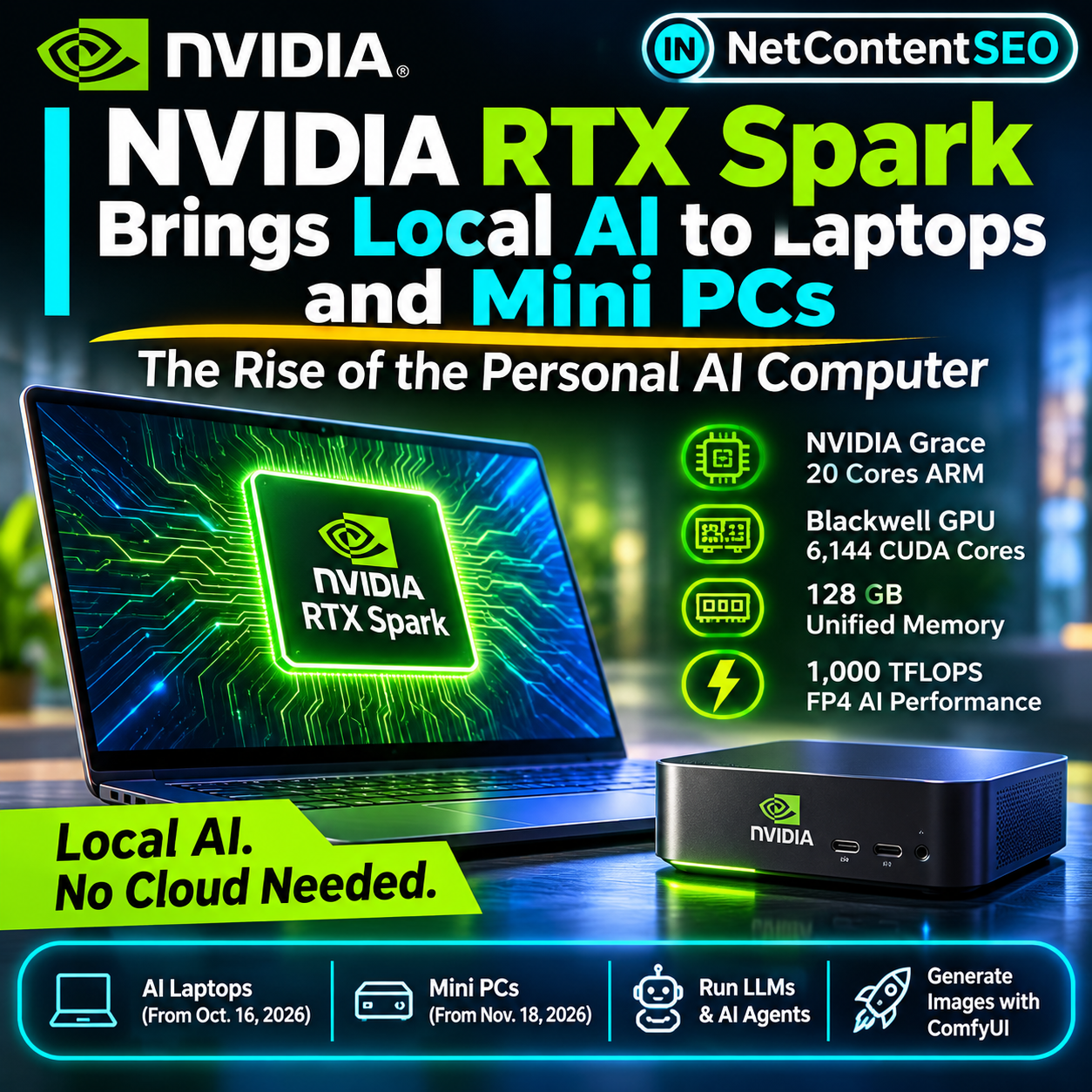

NVIDIA's RTX Spark platform represents a shift toward personal computers designed to execute AI workloads locally. Following the October laptop introduction, NVIDIA announced desktop availability on November 18, 2026. The development is particularly relevant to developers building private AI assistants, creative workflows and agentic applications.
From laptops to compact AI workstations
NVIDIA's laptop announcement and desktop announcement describe a platform combining Grace CPU technology and Blackwell RTX graphics. The highest advertised configuration includes a 20-core Arm CPU, 6,144 CUDA cores and 128 GB of unified memory, with up to 1,000 TFLOPS of FP4 AI performance. These are vendor specifications, not independently measured application performance. Individual systems may have different configurations.
Why unified memory matters
Large language models require memory for weights, runtime state and context. A shared memory architecture can reduce the need to transfer data between separate CPU and GPU memory pools. It also provides flexibility when running workloads that exceed the dedicated graphics memory of conventional consumer GPUs.
However, 128 GB of unified memory does not mean that all 128 GB are available to a model. The operating system, applications and inference runtime also require resources. Quantization, context length and memory bandwidth affect the size and speed of models that can run comfortably.
What local AI changes
A local inference system can process supported workloads without transmitting every prompt to a remote model provider. This can improve control over confidential documents and reduce dependence on per-request cloud pricing. It does not eliminate hardware, electricity, maintenance or software costs. Applications requiring current online information still need network access and reliable retrieval services.
AI agents and creative production
Potential workloads include document analysis, coding assistance, retrieval-augmented generation and image creation through compatible tools such as ComfyUI. An editorial workflow could retrieve primary sources, extract relevant facts, draft an article and generate its cover using local models. Human review and source validation remain essential. GPU acceleration cannot establish whether a generated claim is true.
What developers should verify before buying
Arm compatibility is an important consideration. Developers should check native support for their operating system, inference engines, Python dependencies, GPU libraries and model formats. Advertised FP4 throughput is a theoretical performance measure and cannot be converted directly into tokens per second. Independent tests should examine prompt processing, generation speed, sustained power consumption, thermal behavior and concurrent workloads.
Local AI versus cloud AI
Local systems offer control and predictable access to installed models, while cloud services can provide access to larger models and managed infrastructure. A hybrid architecture may be appropriate when private document processing happens locally but demanding reasoning or online retrieval requires external services. The best configuration depends on workload, confidentiality requirements and total cost.
Implications for SEO and AI Search
RTX Spark is not a search ranking update. Its significance for SEO and GEO is indirect: more capable personal computers could make it easier to deploy independent research agents and specialized retrieval systems. Such systems might use different search providers, private indexes or curated document collections. Publishers should not assume that a local model automatically accesses their website or cites their content.
For AI visibility measurement, distinguish the model from its retrieval infrastructure. A model running offline cannot retrieve a newly published article unless that information is supplied through a local index or another connected tool. Reliable citations require explicit provenance and validation, regardless of where inference occurs.
The bottom line
The emerging personal AI computer is not simply a faster laptop. It offers another deployment option for software that combines inference, retrieval and automation. NVIDIA's platform is an important development to watch, but real-world benchmarks, software compatibility and system pricing will determine its practical value.
Sources: NVIDIA laptop announcement; NVIDIA desktop announcement.