

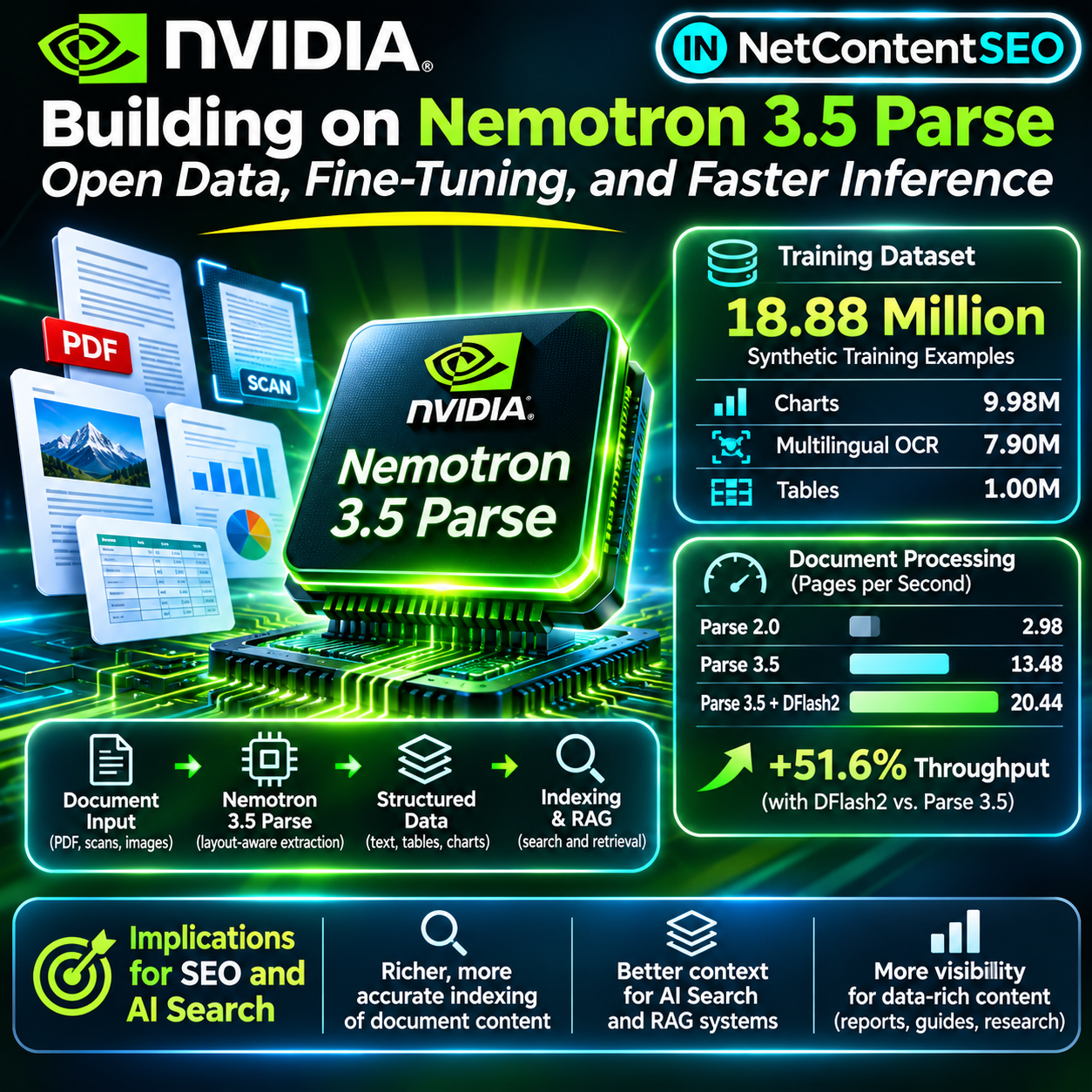

On November 26, 2026, NVIDIA published an expansion of its document intelligence toolkit on Hugging Face. The update combines training datasets, a customization recipe and inference optimization for a parser originally released in October.
For AI search developers, the significance lies in converting visual evidence into searchable records before an answer is generated. The official model documentation describes layout-aware extraction with page coordinates and reading order. The model repository identifies a 631-million-parameter model.
18.88 million synthetic training examples
Charts — 9.98 million
Tables — 1 million
Multilingual OCR — 7.9 million
Source: NVIDIA, November 26. Counts summed across the three datasets.
These resources allow developers to adapt extraction to document layouts with known reference answers. A synthetic chart has an underlying numerical representation, making it possible to test whether a parser preserves information rather than merely producing plausible text.
Training for reliable extraction
NVIDIA combines supervised fine-tuning with reinforcement learning using verifiable rewards. The development comparison reported 126 repetitive outputs before reinforcement learning versus 29 afterward. These are intermediate checkpoint results, not an independent production evaluation.
Inference throughput
Parse 2.0 — 2.98
Parse 3.5 without speculation — 13.48
Parse 3.5 with DFlash2 — 20.44
NVIDIA benchmark: one H200, BF16, 2,078 pages. Hardware-specific results.
Speculative decoding lets a smaller drafter propose output for verification by the target model. The reported high-concurrency improvement is approximately 52% relative to Parse 3.5 without speculation. Real-world performance depends on workloads, hardware and quality requirements.
From PDF to evidence-backed AI answers
↓
↓
↓
↓
NetContentSEO proposed RAG architecture, not a Google ranking system.
Implications for SEO and GEO
Publishers frequently place important evidence in downloadable research, product sheets and statistical reports. Traditional text extraction can lose the relationship between a figure and its header, or between a chart and its units. Better parsers could make these documents more useful to retrieval systems that adopt such technology.
However, an extraction benchmark does not establish that Google, Bing or ChatGPT uses this particular parser. Nor does it demonstrate a ranking or citation advantage. Publishers should continue providing accessible HTML summaries, semantic tables, descriptive captions and searchable PDFs. Ensure that the units, date, methodology and source of numerical claims remain clear outside the original visual context.
How to evaluate a document retrieval pipeline
Build a test set with scanned pages, multilingual reports, dense tables and charts. Measure numerical fidelity, row-column alignment, missing content and page-level attribution before measuring answer accuracy. Retain original documents and extraction coordinates to support auditing. Reprocess difficult regions selectively rather than assuming that every page requires the same amount of computation.
For GEO monitoring, distinguish document retrieval from actual citation visibility. A document can be parsed accurately without being selected as a source. Conversely, a citation can point to a document whose extracted details are incorrect. Evaluate these stages separately.
Conclusion
The update reinforces the importance of document processing as a separate component of AI search infrastructure. Faster extraction and adaptable training resources are useful developments, but reliable answers still depend on retrieval, evidence validation and appropriate attribution.
Source note: The November 26 announcement was verified through indexed primary-source text; direct page retrieval failed. Performance results are vendor-reported.