

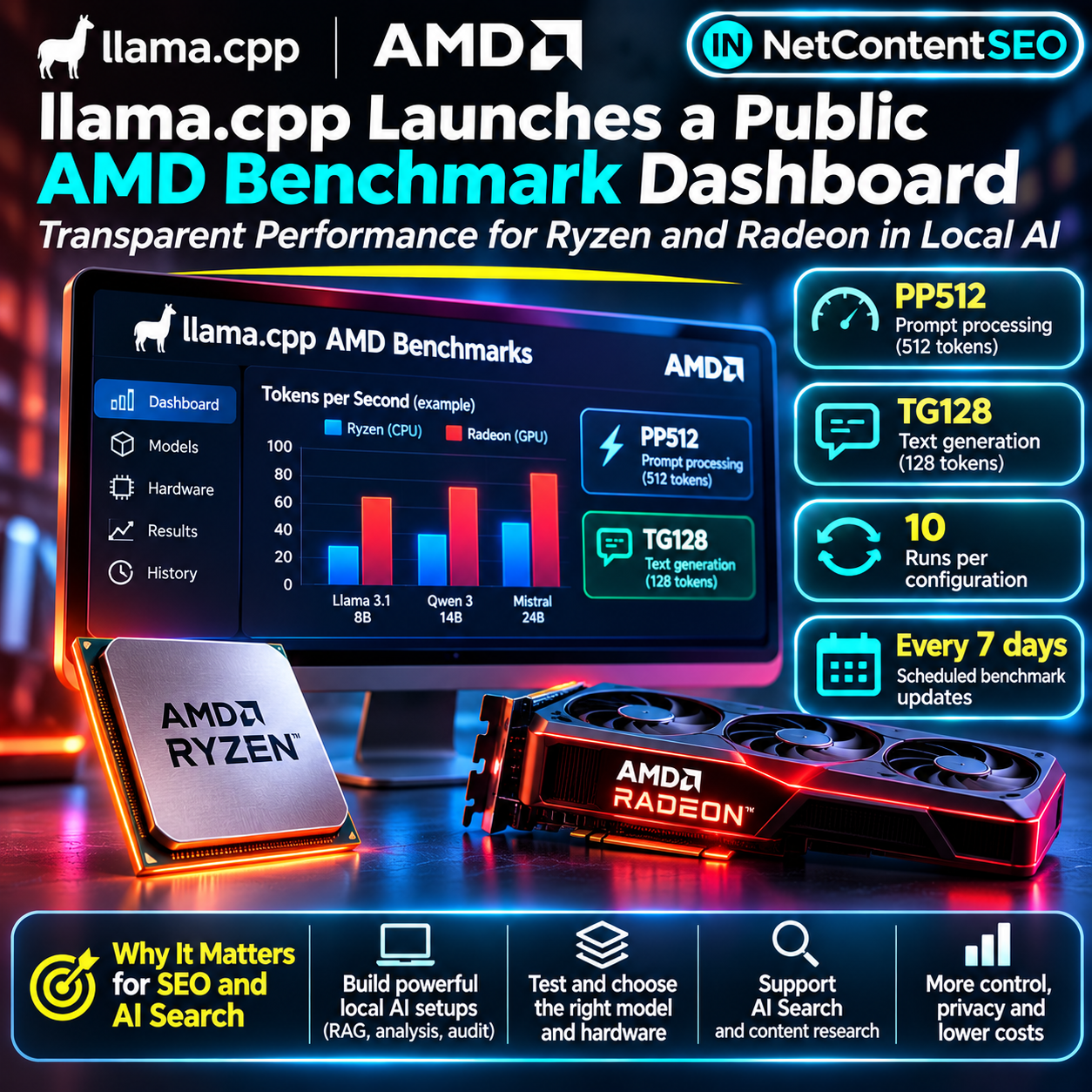

On November 26, 2026, ggml-org announced a public AMD inference benchmark explorer on Hugging Face. Rather than introducing another language model, the project gives developers a way to investigate how software revisions and model formats affect local inference.
What the dashboard measures
512
Input tokens processed without output generation
128
Output tokens generated from an initially empty context
These are distinct throughput measurements, not directly comparable workload sizes or latency measurements. Prompt ingestion matters for document-heavy requests, while generation speed affects the time required to produce a response. Neither measure alone captures end-to-end application performance.
Hardware and repeatability
Initial coverage is limited to Radeon 8060S (gfx1151) and Radeon AI Pro R9700S (gfx1201). The test matrix spans several model families and precision configurations. Weekly public workflows use llama-bench with and without Flash Attention, repeating each configuration ten times. AMD contributed testing infrastructure.
Developers can explore results through the dashboard and inspect the underlying public data. The installation project provides the relevant build workflow.
From benchmark selection to production validation
↓
↓
↓
Why context scaling matters for AI Search
A retrieval-augmented generation system may assemble evidence from multiple pages before asking a model to produce an answer. Its workload is substantially different from a short empty-context generation test. Longer inputs, conversation history and repeated tool interactions may make memory consumption and sustained throughput more important than a headline speed figure.
Teams should evaluate document ingestion, retrieval latency, answer generation and citation accuracy independently. Quantization can reduce weight storage requirements, but its impact on speed and answer quality must be measured for the chosen model and hardware.
Implications for technical SEO and GEO
Local models can support content classification, metadata analysis, document summarization and experiments with evidence-backed search. Public performance data can help teams narrow the configurations worth testing before investing in hardware or changing their software stack. Local inference does not eliminate electricity, maintenance or data acquisition costs.
These benchmarks do not measure Google rankings, AI citation visibility or the accuracy of generated answers. For a GEO monitoring system, faster inference is useful only when measurement validity is preserved. Keep engine-specific citations, retrieval failures and answer quality separate from hardware performance.
Practical evaluation checklist
| Measurement | Application relevance |
|---|---|
| Prompt throughput | Processing retrieved evidence |
| Generation throughput | Producing reports and answers |
| Context scaling | Long documents and multi-turn research |
| Peak memory | Deployment feasibility |
| Evidence accuracy | Reliable SEO and GEO analysis |
The last two measurements are additional recommended application tests, not claimed dashboard features. Record exact model files, build identifiers, settings and workload definitions so comparisons remain reproducible.
Conclusion
The most useful aspect of the announcement is its emphasis on inspectable, recurring measurements. A public benchmark history can reveal regressions that isolated reviews miss. However, the initial hardware coverage is narrow, and no specific throughput comparison is established in this article. The announcement was verified through indexed primary-source text; direct page retrieval failed. No independent benchmark replication was performed.