
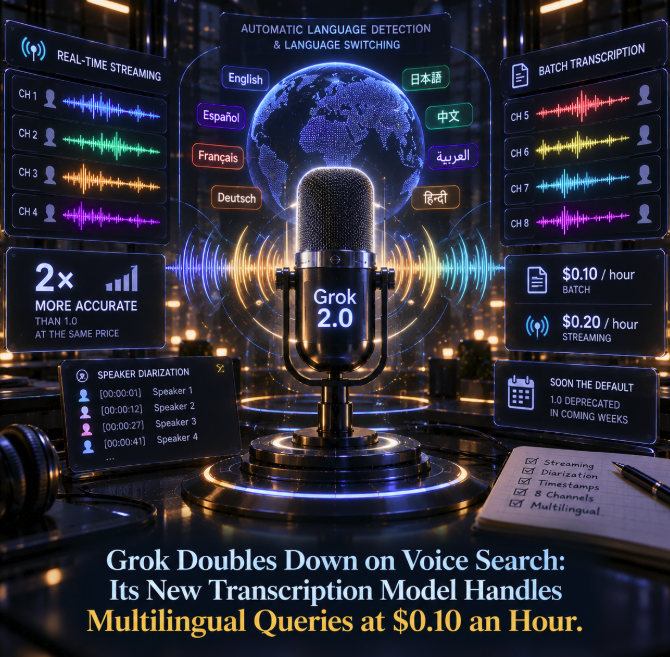
SpaceXAI has released Grok Voice Transcribe 2.0, a new speech-to-text model aimed at the messy audio conditions that increasingly sit between users and AI systems: multilingual voice commands, noisy calls, multiple speakers, live streams and recordings where the language can change halfway through. The company says the model is twice as accurate as Grok Voice Transcribe 1.0 across its real-world evaluations while keeping exactly the same price.
The official September 18 announcement puts the economics at $0.10 per hour of audio for batch transcription and $0.20 per hour for streaming. Speaker diarization, timestamps and key-term controls are included. Grok Voice Transcribe 2.0 is available through the Speech-to-Text API now, will soon become the default model, and the 1.0 version is scheduled for deprecation in the coming weeks.
The largest improvement is multilingual speech
SpaceXAI describes multilingual accuracy as the biggest advance over the first-generation model. Grok Voice Transcribe 2.0 supports dozens of languages, automatically detects the language being spoken and can follow language switches within a single recording without requiring a separate transcription pass.
That last capability matters for real voice interfaces. Users do not always stay inside one language, particularly in customer support, travel, multilingual households, international workplaces and markets where English product terminology is mixed into local speech. A transcription layer that requires the application to know the language before processing the audio creates friction precisely where voice is supposed to remove it.
SpaceXAI reports a particularly large improvement on short multilingual phrases, the kind of input common in voice assistants and in-car commands. On its internal short-phrase dataset spanning 19 languages, the company says word error rate fell from 20.6% with Grok Voice Transcribe 1.0 to 6.8% with version 2.0. Those are company-reported internal results rather than an independent benchmark, so they should be interpreted accordingly.
SpaceXAI says accuracy doubled at the same price
The company's broader claim is that the new model is twice as accurate as its predecessor at unchanged pricing. SpaceXAI says it evaluates the system on production-derived datasets covering customer-support telephony, conversations with Grok, spoken credentials such as phone numbers and email addresses, and multilingual voice commands.
The model is built on the audio foundation model behind Grok Voice and trained on live, noisy and multilingual recordings across varied environments. SpaceXAI says Grok Voice already handles tens of thousands of customer-support calls per day, millions of hours of video narration and voice-agent workloads in physical products, including the Grok assistant in Tesla vehicles.
For an external reference point, SpaceXAI also points to Artificial Analysis, where it says Grok Voice Transcribe 2.0 ranks first for accuracy among 32 streaming models on the public leaderboard at the time of the announcement. Benchmark leadership can change as models and evaluations are updated, but the combination of external and internal testing indicates that transcription quality is the central positioning of this release rather than simply another API feature expansion.
The API is designed for more than clean single-speaker recordings
Grok Voice Transcribe 2.0 supports both batch files and real-time audio streams. Developers can request word-level timestamps with start and end times and confidence scores, label individual speakers through diarization, and transcribe as many as eight audio channels independently.
The multichannel capability is particularly useful for call centers and recorded conversations where participants are captured on separate tracks. Instead of asking the model to infer who spoke from one mixed audio stream, an application can preserve channel separation and obtain cleaner downstream transcripts.
Developers can also provide as many as 100 key terms per request to bias recognition toward domain-specific language such as product names, specialist vocabulary or terminology that generic speech systems may otherwise mishear. The API can format numbers, dates, currencies, phone numbers and email addresses into written form, remove filler words such as “um” and “uh,” and use smart turn detection to identify when a speaker has finished talking.
Existing integrations can receive the upgrade without code changes
SpaceXAI says existing Speech-to-Text API integrations can receive the accuracy improvement without changing application code. That makes the planned default-model transition operationally important: developers who rely on the unpinned default can move to version 2.0 automatically once SpaceXAI switches the API over.
Teams that need additional time to validate behavior can pin grok-voice-transcribe-1.0 during the transition. That option is temporary because SpaceXAI says the older model will be deprecated in the coming weeks. Applications with sensitive transcription workflows should therefore test version 2.0 rather than assuming that a model change with the same API surface will produce identical transcripts.
Improved accuracy can itself alter downstream behavior. If transcripts feed search, summarization, compliance systems, CRM records or autonomous agents, different punctuation, entity recognition and speaker attribution can change the data consumed by the next stage even when the integration code remains untouched.
Atlassian is already using the model for Loom
The launch is not limited to a benchmark demonstration. SpaceXAI says Atlassian found Grok Voice Transcribe 2.0 more accurate than its existing solution for transcribing Loom videos. The company highlights a workflow in which a user records instructions in Loom, Grok produces the transcript and the text can then be passed into Cursor to make code changes.
That example illustrates why transcription models increasingly belong to the agent stack rather than only the accessibility or captioning stack. Once spoken language becomes reliable structured text, it can act as input to search systems, coding agents, support automation, analytics and other models. Speech recognition is becoming the front door to workflows that previously started with a typed prompt.
The voice-search implication is broader than traditional voice SEO
For search marketers, “voice search” historically meant optimizing for spoken queries sent to assistants such as Google Assistant, Siri or Alexa. The emerging model is broader. Voice is increasingly an input modality for general-purpose AI assistants and agents that can search the web, reason over results and take actions.
Better transcription therefore improves the first stage of AI search: converting what the user actually said into a textual representation that the retrieval or reasoning system can understand. Automatic language detection and mid-recording language switching are particularly relevant because they reduce the need for the user to adapt to the interface before asking a question.
This release does not mean Grok has announced a new search-ranking system, nor does a transcription API directly change SEO rankings. The connection is infrastructural. As speech recognition becomes cheaper and more accurate, more search-like and agentic interactions can begin as audio rather than text.
$0.10 per hour makes large-scale transcription inexpensive
The batch price is notable because an hour of recorded audio costs ten cents to transcribe before any other API or infrastructure charges. Streaming costs twice as much at $0.20 per hour but supports real-time interaction. SpaceXAI says those rates are unchanged from version 1.0 despite the claimed accuracy improvement.
At that level, transcription can become practical for workloads far larger than manually selected recordings: support archives, meetings, podcasts, video libraries, voice notes and continuous agent interactions. The economic question moves from whether audio is worth transcribing at all to what organizations can do with a searchable text layer once the transcription exists.
That has implications for content discovery as well. Large audio and video archives become easier to segment, summarize, index internally and feed into retrieval systems when transcription is cheap enough to run by default. The value does not come only from captions; it comes from making spoken information computationally accessible.
Accuracy claims still need workload-specific testing
No speech-to-text benchmark eliminates the need for application-specific evaluation. Error rates vary with microphones, accents, domain vocabulary, background noise, speaker overlap and recording quality. A model that performs strongly on one benchmark can behave differently on specialized medical, legal or industrial language.
The new key-term biasing, confidence scores and multichannel features give developers tools to manage some of those conditions, but production testing remains essential. This is particularly true when a transcript is not merely displayed to a human but passed automatically into another AI system that may treat an incorrectly recognized word as authoritative input.
The transition from 1.0 also provides a natural evaluation window. Teams can compare transcripts across representative production audio before the older model disappears, measuring not only aggregate word error rate but also the specific entities and commands that matter to their application.
Voice is becoming another high-volume AI interface
Grok Voice Transcribe 2.0 fits a broader shift in how AI products are being built. Text boxes remain important, but assistants increasingly need to understand conversations, calls, videos and physical-world interactions in real time. The quality and cost of speech recognition determine how reliably those systems can turn human language into something an AI agent can act on.
SpaceXAI's release combines three elements that make that transition easier: lower error rates, multilingual flexibility and pricing that supports high-volume use. Streaming, diarization, timestamps and eight-channel transcription then make the same model usable across interactive assistants and enterprise recording workflows.
For search and discovery, the important development is not simply that Grok can produce better transcripts. It is that spoken, multilingual input is becoming cheap enough and structured enough to function as a routine entry point into AI retrieval and agent workflows. At $0.10 per batch hour, voice is increasingly less of a special interface and more of another searchable data layer.