
The largest bank in the market is not necessarily the bank an AI assistant will recommend. As consumers increasingly ask conversational systems which savings account, credit card or financial institution best fits a particular need, the traditional advantages of scale, branch networks and broad name recognition are colliding with a different kind of visibility: the ability to appear convincingly in product-specific AI answers.
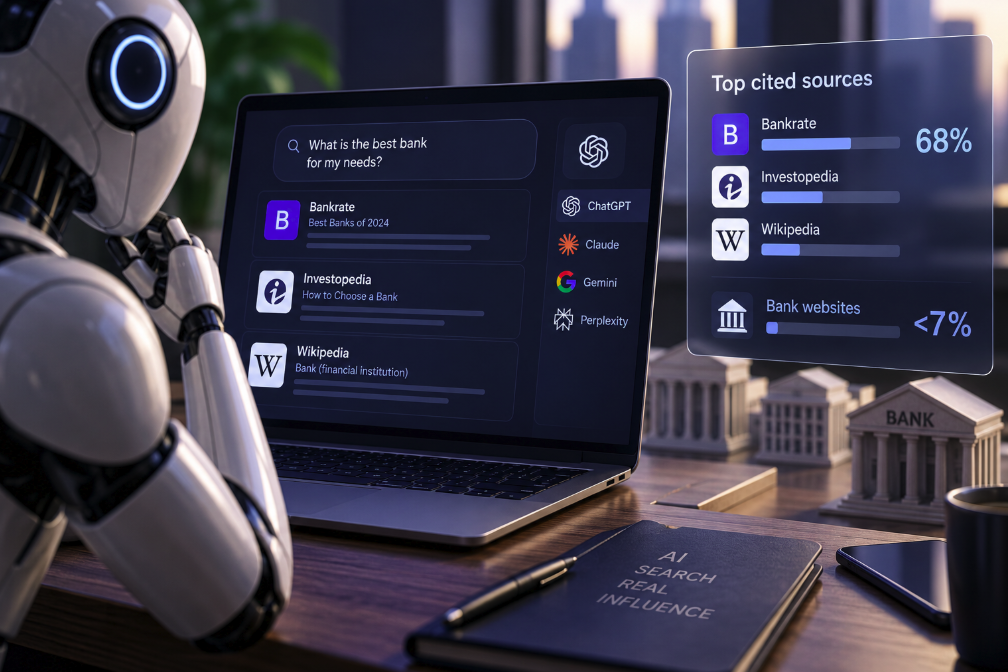
A new banking AI search analysis from 5WPR illustrates just how different that environment can be. In one study covering 31,500 prompts across five AI assistants between January and May 2026, Bankrate, Investopedia and Wikipedia supplied 68% of banking-related AI citations, while bank-owned domains accounted for less than 7%. The implication is significant: even when an AI system recommends a bank, much of the evidence shaping that recommendation may come from publishers and reference sites rather than the institution itself.
AI answers organize banking around the consumer’s question
Traditional banking leadership is usually discussed through assets, deposits, customer numbers, branch footprints and decades of accumulated trust. AI search does not ignore those signals, but it can reorganize the competitive field around a much narrower question. Someone asking for the best high-yield savings account is not necessarily asking for the biggest bank. A freelancer looking for a checking account or a traveler comparing credit cards creates a different competitive set with every prompt.
5WPR’s separate Banks AI Visibility Index tested 66 consumer-intent prompts across ChatGPT, Claude, Perplexity, Gemini and Google AI Overviews during the second quarter of 2026. Those prompts covered categories including high-yield savings, checking, CDs and money markets, credit cards, small-business banking, and wealth and brokerage. Ally led estimated AI citation share at 9.2%, ahead of JPMorgan Chase at 7.8%, SoFi at 6.5% and Marcus by Goldman Sachs at 5.4%.
The result does not establish that one institution offers better financial products than another, and the research explicitly describes the analysis as a measure of communications and discovery rather than financial advice. What it does show is that institutional size and AI recommendation visibility are not interchangeable. The study notes that the Big Four represented roughly 77% of deposits among the top 50 U.S. banks, yet their share of consumer-banking AI recommendations was considerably smaller. Wells Fargo, despite approximately $1.9 trillion in assets, ranked 22nd in that study.
Bankrate, Investopedia and Wikipedia are shaping the evidence layer
The citation data may be even more important than the recommendation rankings. If three external information sources account for 68% of banking-related citations while banks’ own domains remain below 7%, financial institutions face a familiar marketing challenge in a new form: they can be the subject of the answer without controlling the sources used to construct it.
Owned content still matters because bank websites remain the authoritative location for rates, fees, eligibility rules, product terms and official corporate information. But generative search adds an intermediary layer. AI systems may retrieve independent comparisons, explainers, reference pages and other third-party material before summarizing which institutions appear suitable for a consumer’s request. That means the information environment surrounding a bank can become nearly as important as the information published by the bank itself.
This is a fundamental shift from conventional search strategy. In a traditional search results page, a bank can compete to rank its own landing page and bring the customer directly into an owned digital journey. In an AI answer, the institution may be recommended while the supporting citation sends the user to an external publisher. The brand wins consideration, but another website wins authority and potentially the click.
Fintech brands can compete above their weight
The research also helps explain why digital-first financial brands can outperform institutions with vastly larger balance sheets. In the 31,500-prompt analysis, challengers including Chime, SoFi, Ally and Discover ranked within the consumer-banking top 12 and out-cited several larger regional banks. 5WPR attributes part of that performance to digital-native content ecosystems and stronger representation across the third-party sources that AI systems frequently cite.
That distinction between market presence and information presence is becoming central to generative engine optimization. A bank may have millions of customers and enormous real-world distribution but still be relatively weak in the pages AI systems retrieve for a particular question. Conversely, a fintech company with a narrower physical footprint can become highly visible if its products are consistently discussed, compared and explained across sources that generative systems treat as useful evidence.
The competitive unit therefore becomes smaller than the corporate brand. Instead of asking whether an institution is visible in AI search overall, marketers increasingly need to know whether it appears for specific intents: emergency savings, small-business accounts, travel rewards, first-time credit cards, brokerage services or other consumer needs. Different prompts can create different winners.
AI visibility also carries reputational memory
There is another consequence for financial communications teams: generative systems can continue surfacing information after the business itself has changed. The 5WPR analysis reports that Goldman Sachs’ former Marcus retail positioning continued to appear in AI responses following changes to the business. Failed institutions including First Republic, Silicon Valley Bank and Signature Bank also continued to surface in safety-related contexts as cautionary references.
This does not mean an AI model will preserve an outdated narrative forever. The methodology describes these rankings as directional measurements taken during a defined period rather than permanent or deterministic results. Still, it demonstrates why simply updating an owned website may not immediately change the broader information environment. Older reporting, reference pages and comparison content can remain retrievable and continue influencing how an institution is summarized.
Bank marketing now has to optimize an ecosystem, not only a website
For financial institutions, the strategic response is broader than adding more SEO pages. Product information needs to be clear, current and easy to verify on owned properties, but banks also need to understand which independent sources repeatedly appear when AI systems answer the questions their customers ask. Credible third-party coverage, accurate reference information and strong subject-matter expertise can all contribute to an information ecosystem that reinforces the bank’s intended positioning.
Measurement also needs to expand beyond branded searches. A communications team that checks only whether an AI assistant recognizes the bank’s name may miss the more commercially important question: whether that bank appears when consumers ask for a specific product recommendation. Monitoring across multiple AI engines matters as well, because different systems can retrieve different sources and construct different competitive sets.
The emerging lesson is simple but disruptive. Banking scale remains enormously important in the real economy, but it does not automatically translate into dominance inside AI-generated recommendations. In generative search, the institution with the most branches, deposits or assets can lose a specific consumer question to a smaller digital competitor with stronger product relevance and a better-established information footprint.
The new contest is therefore not merely about being the biggest bank or even the best-known bank. It is about becoming the bank that AI systems can confidently surface for the right question, describe accurately and support with credible evidence. As AI becomes another gateway into financial discovery, that difference could determine which institutions enter the consumer’s consideration set before they ever visit a bank website.