
The emerging market for paying publishers when AI systems consume their work is not converging on a single unit of value. It is splitting into several. One platform can pay when a crawler successfully retrieves a page, another when content appears in a search result, another when licensed material is used to ground an answer, and Google is piloting a model in which the platform itself decides whether a publisher's contribution was sufficiently significant to deserve compensation.
A new Search Engine Journal comparison published September 18 puts those experiments side by side. The most useful way to read them is not simply as competing payment programs, but as competing definitions of the event that creates economic value. In AI search, “the content was accessed” and “the content mattered to the answer” are no longer necessarily the same billable event.
Google is paying for a contribution it judges “significant”
Google's invitation-only AI contribution pilot takes the most platform-defined approach. According to the reporting summarized by Search Engine Journal, participating publishers are paid when Google determines that their content contributed significantly to an AI-generated response across Gemini, AI Overviews or AI Mode. Merely confirming information or linking to a source after the response has already been generated does not qualify under the reported model.
The crucial word is “significantly.” Google has not publicly disclosed the formula it uses to determine that threshold. Participants reportedly receive monthly earnings information and some history through an AI contribution panel in Search Console, but the calculation behind an individual payment is not exposed.
This creates a fundamentally different relationship from pay-per-crawl. The publisher does not set a unit price for a page request and cannot independently observe the event that Google considers payable. Google's system evaluates the contribution and determines whether it crosses an internal value threshold.
That does not make the model inherently better or worse than a mechanical payment trigger. It does make the economics more dependent on the platform's attribution logic. For publishers, understanding whether a page was crawled or even cited may not explain why it did or did not earn money.
Cloudflare's Pay Per Crawl makes the retrieval itself the transaction
Cloudflare starts from a much more observable event. Its Pay Per Crawl product is currently in closed beta and lets site owners charge AI crawlers for access. The publisher chooses whether a crawler is allowed, blocked or charged, while Cloudflare provides the infrastructure and acts as merchant of record.
Cloudflare's documentation defines the payment event mechanically: a successful paid content retrieval returning HTTP 200. Site owners can set a default price, with a documented minimum of $0.001 per crawl, and can use dynamic pricing to vary prices for different content. Repeated retrievals can create repeated charges.
This model gives the publisher unusually direct control over the price of access. It also exposes its main weakness: a crawl is not necessarily a useful measure of downstream value. A page can be fetched repeatedly and never influence an answer, while another page could theoretically be fetched once and then support many AI interactions.
Cloudflare itself now makes that criticism. In its July 2026 AI search announcement, the company called crawling a crude measure of value and described a move toward experiments that compensate creators based on how content is actually used.
Pay Per Use splits into multiple models of its own
Cloudflare's emerging Pay Per Use direction is less a single tariff than infrastructure for multiple AI companies to bring their own compensation logic. The company is experimenting with providers including Ceramic.ai and You.com, and those examples already show that “use” can mean different things.
Ceramic describes its approach as pay per query: participating publishers can be compensated when their content appears in Ceramic's search results. Cloudflare says the accompanying reporting can show top queries, the specific page and snippet surfaced, and average search-result position. That ties compensation and reporting to a visible retrieval/result event closer to the user's question.
You.com represents another model. Cloudflare describes agents paying on demand when they need a specific piece of premium content. Other possible mechanisms include pay per result. In all of these cases, the economic event occurs later than a crawler merely fetching a page.
The difference is important because the same article could pass through several technical stages before generating a payment: it can be crawled, indexed or otherwise made retrievable, selected for a query, incorporated into an answer, and potentially cited to the user. Different programs can attach money to different points in that chain.
Microsoft is building licensing around “delivered value”
Microsoft's Publisher Content Marketplace, announced in February, takes another route. Rather than defining a public per-crawl fee, Microsoft describes a marketplace where publishers define licensing and usage terms and AI builders license premium content for specific grounding scenarios.
Microsoft says publishers will be paid based on “delivered value” and receive usage-based reporting. Participation is voluntary, publishers retain ownership and editorial independence, and Microsoft says the marketplace is intended to scale licensing beyond one-to-one agreements between individual publishers and AI companies.
What Microsoft has not publicly specified is just as important. Its announcement does not define a universal payable event equivalent to Cloudflare's HTTP 200 retrieval. Nor does the public description explain exactly what fields the usage reports contain or provide a formula for “delivered value.” The program has been co-designed with publishers and began with grounding scenarios in Microsoft Copilot, with Yahoo among the demand partners being onboarded.
Microsoft therefore gives publishers more explicit control over licensing and usage terms than Google's publicly described pilot, while leaving the precise value event less mechanically defined than Cloudflare Pay Per Crawl.
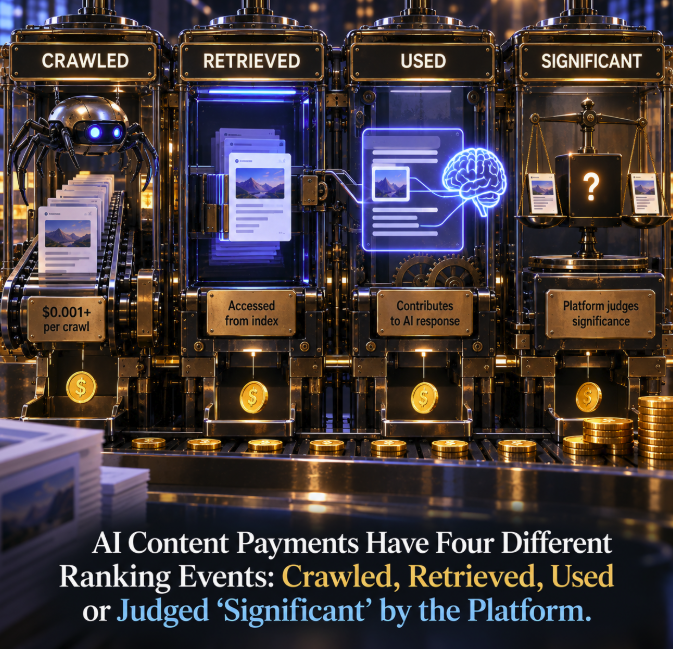
The four useful stages are crawled, retrieved, used and valued
For publishers trying to understand these systems, it helps to stop treating “AI used my content” as one event. There are at least four economically distinct stages emerging from the current experiments.
Crawled means the AI operator fetched the page. Cloudflare Pay Per Crawl can make that request itself payable. Retrieved means the content was selected from an available corpus in response to a query or need; models such as Ceramic's pay-per-query approach move closer to this stage. Used means the content contributes to grounding or constructing an AI experience, the territory addressed by licensing marketplaces and pay-per-use systems. Valued or significant adds another judgment: the platform determines that the contribution was meaningful enough to trigger compensation, as reported in Google's pilot.
These are not formal industry-standard definitions, and the programs do not all use this vocabulary. They are a useful analytical model for understanding why two publisher-payment systems can both claim to pay for AI content while compensating completely different events.
Citation is not necessarily the payment event
One of the most consequential implications is that a visible citation does not necessarily tell a publisher whether compensation occurred. Google's reported pilot distinguishes content that materially contributes to generation from information that merely confirms or links after the answer has been created. Conversely, a system could license or retrieve premium content even when the final interface does not display a conventional citation in the way an SEO tool expects.
That means future publisher analytics may need to separate citation visibility from economic attribution. A URL appearing in an AI response is useful evidence of source selection, but it is not automatically evidence that the content crossed a platform's payment threshold.
The reverse can also matter. A system might consider content valuable during grounding while presenting the final user experience through another source-selection or linking layer. Without transparent reporting, publishers cannot reconstruct the economics simply by scraping visible AI citations.
The amount of publisher control varies dramatically
The current programs also distribute pricing power differently. Cloudflare Pay Per Crawl lets a site owner set the access price and decide whether individual crawlers are allowed, charged or blocked. Its dynamic-pricing capabilities can vary pricing by content path or request properties.
Microsoft says publishers define licensing and usage terms inside its marketplace. Google, based on the currently reported pilot, provides the decision to participate or opt out but has not publicly described an equivalent publisher-controlled per-use price or transparent significance formula. Cloudflare's Pay Per Use experiments sit somewhere in between because each participating AI company can bring a different payment model.
This may become one of the central strategic choices for publishers. A publisher-controlled access price is transparent but may value every retrieval too similarly. A platform-controlled outcome model can theoretically distinguish high-value use from low-value access, but requires the publisher to trust an attribution system it may not be able to audit.
Reporting could become as important as the payment rate
The programs are also competing on information. Cloudflare's Ceramic example promises query, page, snippet and average-position data. Microsoft promises usage-based reporting intended to show publishers how content has been valued and where it could provide more value. Google's reported pilot shows monthly earnings and some historical information, but not the calculation that produced the payment.
For publishers, that difference affects more than accounting. Detailed usage data can become an editorial signal. If a publisher can see which questions repeatedly retrieve its reporting, which pages are selected and which snippets are useful, it can understand how its archive participates in AI search in a way that raw revenue totals cannot explain.
This is beginning to resemble the role search analytics played in the traditional web, except the events are more complicated. Search Console could tell a publisher about impressions, queries, positions and clicks. AI systems may need to explain retrieval, grounding, citation, answer contribution and payment — potentially as separate metrics.
Charging search crawlers creates a difficult trade-off
There is an additional complication for sites considering crawl-based monetization. Cloudflare's documentation allows site owners to charge supported crawlers, but search-engine access has consequences beyond AI compensation. Blocking or putting payment requirements in front of a search crawler can interfere with ordinary discovery and indexing.
Cloudflare explicitly cautions site owners about this trade-off. A payment system at the network edge cannot erase the fundamental dependency between search visibility and crawler access. Publishers therefore need to distinguish bots used for model training or AI retrieval from crawlers that also support traditional search surfaces before applying aggressive monetization rules.
This is another reason the market is moving beyond crawl counts. The economically valuable AI event may happen long after the original discovery crawl, and charging the discovery layer can create collateral costs that an outcome-based payment model avoids.
AI content economics are becoming an attribution problem
The larger shift is that publisher compensation is turning into a technical attribution problem. The old web had an observable chain: a search engine indexed a page, displayed a link, a user clicked, and the publisher monetized the visit. AI can break that sequence. A system may crawl content, retrieve it internally, use it to build an answer and satisfy the user without producing the visit that traditionally carried the economic value.
The pilots from Google, Cloudflare and Microsoft are different attempts to insert a payable event somewhere inside that new chain. Cloudflare can monetize access itself. Its Pay Per Use partners can monetize selection or consumption. Microsoft is constructing a licensing marketplace around grounding and delivered value. Google is experimenting with compensation when its systems decide a publisher's contribution to an AI response was significant.
No current pilot establishes the final industry standard, and important details remain private or experimental. Google's significance calculation is opaque publicly. Cloudflare's Pay Per Crawl remains closed beta and Pay Per Use is explicitly experimental. Microsoft's marketplace is still a pilot and does not publicly define its exact payable unit.
The most important question for publishers is therefore no longer simply “Will AI companies pay for content?” It is “Which event will they agree is worth paying for?” Crawling, retrieval, use and meaningful contribution are four different moments in the AI content pipeline. The company that defines the payable moment also defines a large part of the future economics of publishing.