

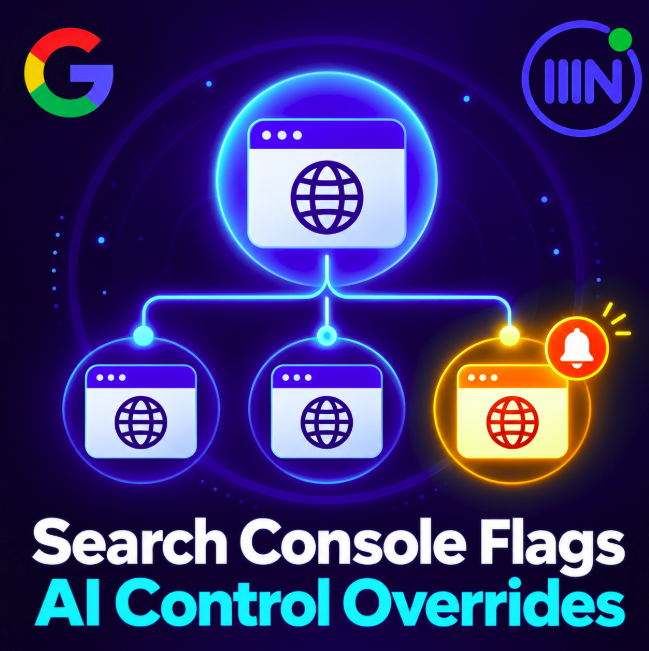

Google’s Search Console documentation now explicitly describes a notification for owners of a top-level domain property when a child property overrides its parent’s Search generative AI setting. For organizations with several publishing teams, the useful implication is visibility into exceptions that can otherwise be missed in a domain-level review.
The wording was verified on October 6, 2026. The official help page does not establish the exact publication time of that sentence, so this is a documented behavior rather than a confirmed feature launch at 13:41 CEST.
What the documentation confirms
The notice appears on the Search generative AI control page for top-level domain owners. Child owners can inherit or manually configure their setting. Inheritance follows the closest parent with a manually configured control, or the top-level domain when none intervenes. Children can include subdomains and URL-prefix properties, not just separate hostnames.
The control covers AI Overviews, AI Mode and generative features in Discover. It is separate from AI training and is not a ranking or inclusion signal for other parts of Search. Google points to Google-Extended for relevant training restrictions.
Why the domain setting is only the start of an audit
Our recommendation is to inspect the property hierarchy whenever an organization reviews its AI participation policy. Reading a single domain setting can be insufficient if a team has configured a more specific property independently.
Consider a hypothetical publisher that applies one policy to its main editorial site and a different policy to a research section. The audit should record both decisions, the affected scopes and the people responsible. It should not flatten the two settings into a single statement that the whole domain is included or excluded.
A notification can prompt that review, but it should not replace the review record. An exception might be deliberate and authorized, or it might need investigation. The alert alone does not identify which organizational interpretation is correct.
Build an exception register
| Record | Reason to retain it |
|---|---|
| Property and scope | Identify exactly which hostname or URL prefix the decision concerns |
| Inheritance status | Distinguish a local decision from a value inherited elsewhere |
| Effective setting | Capture what the team actually intends for that scope |
| Responsible owner | Provide a contact who can explain and review the decision |
| Change date and rationale | Connect later investigations to a documented deployment |
This is an editorial governance recommendation, not a list of fields Google promises to display in the notification. Keep the register in the organization’s own workflow and update it when a property-level decision changes.
Use a deliberate review sequence
Start by recording the domain-level choice. Inventory the relevant child properties, inspect their configurations and identify where inheritance stops. For each exception, ask whether the choice matches the business policy agreed for that content.
Do not change every child automatically to match the domain merely to clear an alert. Some sections may have distinct distribution requirements. Review the reason first, then make an authorized change or document why the exception remains.
When changing settings, capture the previous value and the affected property. Assign follow-up checks to a named owner rather than treating the click as the end of the work.
Keep participation and performance analysis separate
For SEO and AI visibility teams, the main operational benefit is reducing ambiguity during investigations. A section that behaves differently from the rest of the site should trigger a configuration check before the team attributes the difference to content quality, technical accessibility or competitor activity.
That does not mean the notification improves rankings or creates new citation eligibility by itself. Record configuration evidence separately from captured AI answers and performance observations. If a setting changed during the measurement period, flag that change as context rather than claiming it explains every movement.
The next action for multi-property teams
Make property scope part of every AI visibility report. A statement about “the website” should identify whether it refers to the whole domain, a subdomain or a URL prefix, and whether exceptions exist.
Google’s documented notification makes an important governance edge case explicit. The useful response is a maintained map of decisions: which properties inherit, which override and who is accountable for reviewing each exception.