
AI visibility dashboards often compress several very different platforms into one reassuring percentage. A brand might be strong in Perplexity, weak in Gemini and average in ChatGPT, yet the reporting layer turns those outcomes into a single “LLM visibility score” as if every engine represented the same audience opportunity. New referral data makes that assumption increasingly difficult to defend.
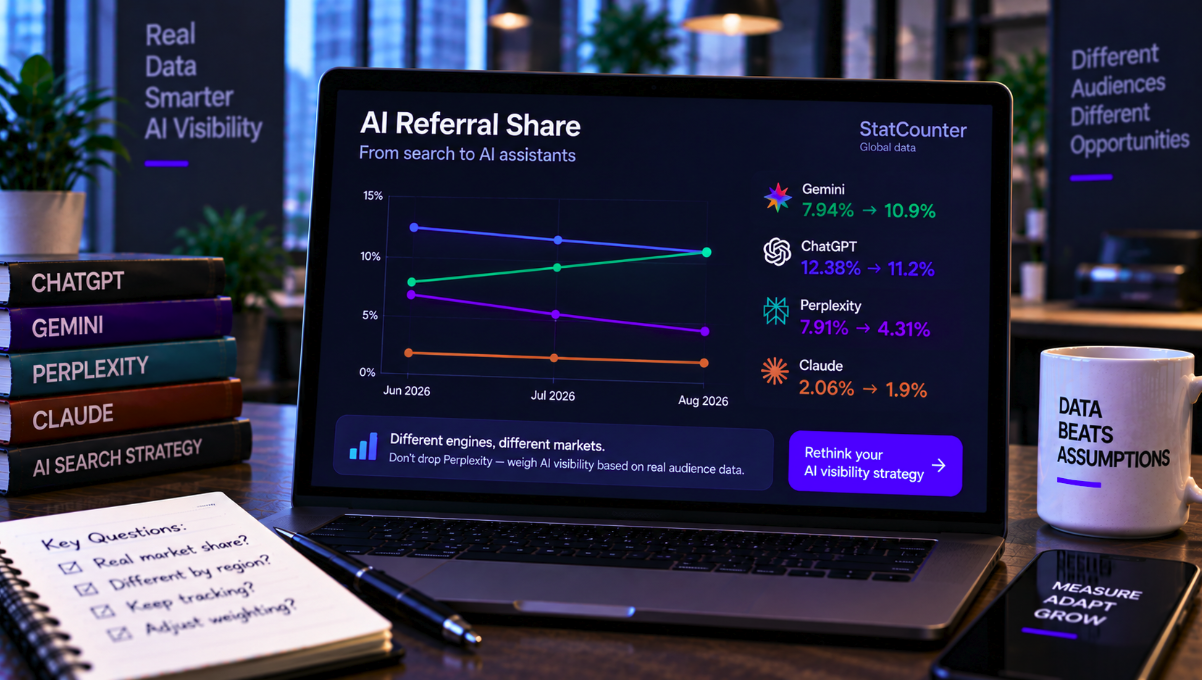
In a September 9 analysis for Search Engine Journal, Greg Jarboe highlights StatCounter data showing Perplexity’s worldwide share of AI chatbot referrals falling from 7.91% in June 2026 to 4.31% in August. Over the same period, Gemini moved in the opposite direction, rising from 7.94% to 10.9%. The divergence supports an increasingly important measurement principle: an AI engine that represents a small fraction of the market or of a company’s actual referral traffic should not automatically contribute as much to an aggregate visibility score as a platform with much greater reach.
That does not mean Perplexity should disappear from every tracker. Jarboe’s argument is explicitly more cautious than a recent recommendation from Siege Media CEO Ross Hudgens to remove Perplexity from LLM tracking. The better conclusion is to stop treating equal weighting as neutral. Visibility metrics should reflect where a business’s audience actually uses AI, where referrals originate and where those visits create commercial value.
Referral share and platform usage are not the same measurement
The first challenge is defining what “market share” means. StatCounter’s figures cited by Search Engine Journal describe AI chatbot referral share: traffic sent from AI assistants to websites. They do not measure every prompt, every user or every interaction that remains inside an AI interface. A platform could generate substantial usage while sending relatively few outbound clicks, while another could represent a smaller user base but produce a disproportionate number of referrals.
Jarboe therefore compares the StatCounter trend with a different dataset from Similarweb. Its May 2026 analysis of worldwide web visits among seven major AI assistants put ChatGPT at 53.9%, Gemini at 27.9%, Claude at 9.2%, DeepSeek at 4.1%, Grok at 2.4%, and Perplexity and Copilot at 1.3% each. Although the denominator differs from referral share, the data reinforces the basic concern: Perplexity is not currently operating at the same scale as ChatGPT or Gemini in these global measurements.
The distinction matters for GEO reporting because a tracker usually measures mentions or citations, while the business ultimately cares about exposure and outcomes. A 70% citation rate on a small platform may be strategically interesting without being economically equivalent to a 40% citation rate on a platform used by far more of the company’s customers.
Equal weighting can turn a clean number into a misleading one
Jarboe illustrates the problem with a hypothetical brand that earns a 40% citation rate on ChatGPT, 35% on Gemini, 30% on Claude and 90% on Perplexity. A simple average produces 48.75%. Mathematically, that calculation is correct; strategically, it may be almost meaningless if Perplexity represents only a small share of the audience or referrals relevant to the business.
The problem becomes more severe when a vendor packages that average as a competitive score. A company could improve dramatically on a low-volume engine and appear to gain overall AI visibility even while losing ground on the platforms responsible for most customer discovery. The reverse can also happen: a deterioration on a small engine can pull down the headline metric despite having negligible impact on traffic, leads or sales.
This is not unique to AI search. Search marketers have long weighted engines, countries, devices and keyword groups according to their importance rather than assuming every observation deserves identical influence. What is new is that the AI market is evolving so quickly that yesterday’s sensible weighting can become obsolete within months.
The market is concentrating, but it is not settled
Perplexity’s decline occurs alongside rapid growth for Gemini and a more established role for Claude. Jarboe argues that the emerging landscape looks less like a winner-take-all market than a multi-tier ecosystem. ChatGPT has enormous direct consumer distribution, Gemini benefits from Google’s broader ecosystem, and Claude has developed a particularly meaningful position in enterprise and professional workflows.
That last point demonstrates why raw consumer share cannot be the only weighting input. A B2B software company selling to developers or large enterprises may care about Claude far more than a consumer retailer does, even if another assistant generates more global web visits. Similarly, a publisher could discover that Perplexity sends unusually engaged referral traffic despite its smaller overall footprint. Market weighting should therefore be contextual rather than a global table copied into every dashboard.
Google’s AI Overviews and AI Mode create another measurement problem because they are embedded in the established Search ecosystem rather than operating solely as standalone chatbot destinations. Jarboe recommends treating them as a separate search-discovery layer instead of simply averaging them with ChatGPT, Gemini and Claude. That avoids mixing fundamentally different distribution systems under one artificial denominator.
Perplexity should be de-weighted where the data warrants it, not erased
The strongest case against deleting Perplexity is that small and irrelevant are not synonyms. Emerging search markets can change rapidly, and a platform with modest global share can still matter in a particular geography, vertical or customer segment. It can also reveal citation patterns that differ from larger competitors and therefore provide useful intelligence about how a brand’s information travels through AI systems.
Jarboe’s recommendation is to place Perplexity alongside emerging or specialized engines such as Grok and DeepSeek rather than treating it as a peer to ChatGPT or Gemini in an overall market-share calculation. Those platforms can remain in monitoring programs without receiving equal influence over the headline score. If Perplexity contributes a meaningful portion of a company’s actual AI referrals—or disproportionately reaches a strategically important audience—its weight can rise accordingly.
This approach also protects teams from overreacting to short-term market movements. StatCounter shows a steep decline between June and August, but two months of referral-share movement do not establish Perplexity’s long-term trajectory. Keeping the platform in the dataset preserves the ability to detect a rebound without allowing its current smaller footprint to dominate executive reporting.
AI visibility needs three layers: exposure, presence and business impact
A more useful measurement system begins by separating three questions. First, where is the target audience actually using AI? Usage estimates, platform visits, geography, industry adoption and referral distribution provide the exposure layer. Second, how visible is the brand on those platforms? That requires tracking mentions, citations, linked URLs and the prompts or tasks that trigger them. Third, what happens afterward? Referral engagement, leads, subscriptions, purchases and other conversions reveal whether visibility has business value.
The weighting should emerge from those layers rather than precede them. A consumer brand might assign the greatest strategic importance to ChatGPT, Gemini and Google’s AI search surfaces because they dominate its audience exposure. A cybersecurity vendor might give Claude considerably more weight because its buyers use it heavily in professional workflows. A publisher might keep Perplexity elevated if its referrals convert unusually well. None of those businesses needs the same universal “AI visibility score.”
This also suggests that weighted scores should remain transparent. Reporting should show the engine-level results and the weights used to construct any aggregate number, allowing teams to see whether an apparent gain comes from a major platform or a small one. Otherwise the sophistication of the weighting simply creates a new black box.
The next generation of GEO dashboards should weight reality, not symmetry
Perplexity’s fall from 7.91% to 4.31% of StatCounter’s measured AI chatbot referral share is not a reason to declare the platform dead. It is a reason to question a measurement convention that was weak from the beginning: giving every AI engine equal influence because equal weighting is easy to calculate.
The AI discovery market is already differentiated by consumer scale, enterprise adoption, search integration, geography and referral behavior. Those differences will grow as assistants develop distinct distribution channels and user bases. A single unweighted average can conceal exactly the information marketers need to make decisions.
For GEO teams, the practical move is therefore not to delete Perplexity but to earn the right to assign every platform its weight. Start with the business’s real audience and referral data, measure visibility engine by engine, then connect those exposures to commercial outcomes. Perplexity may deserve 2% of the attention for one company and 15% for another; Claude may be essential in B2B and secondary in consumer retail. The important shift is abandoning the fiction that symmetry equals accuracy.
AI visibility scores will become more useful when they stop asking, “How visible are we across all engines?” and start asking, “How visible are we where our market actually is?” Perplexity’s declining referral share makes that distinction harder to ignore.