

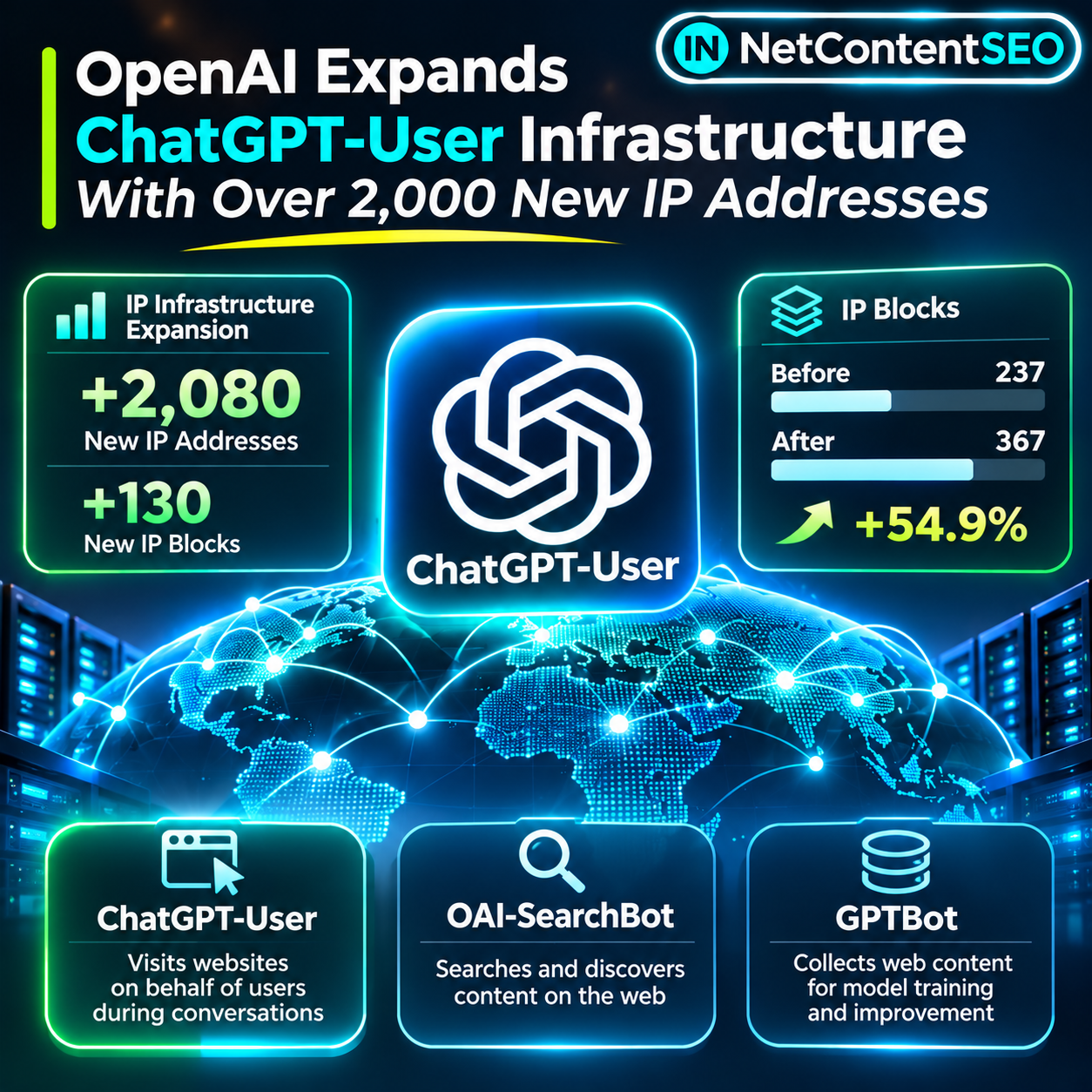

Website operators tracking AI-mediated visits have a new reason to refresh their network verification rules. On November 25, 2026, PPC Land reported that OpenAI's published ChatGPT-User address inventory had expanded by 130 IPv4 prefixes, representing 2,080 additional addresses. IPQuery's inventory independently records 237 prefixes on November 24 and 367 on November 26.
The development concerns ChatGPT-User specifically. It is not evidence of an equivalent expansion of OpenAI's search or training crawlers, nor of increased request volumes. No explanation for the expansion was identified.
What changed in the published network inventory?
2,080
130
54.9%
Published IPv4 prefixes
November 24 — 237
November 26 — 367
Sources: PPC Land comparison and IPQuery historical inventory. Counts represent prefixes, not active servers.
A prefix represents a range of network addresses. Each newly reported /28 contains 16 IPv4 addresses, so 130 such ranges correspond to 2,080 addresses. The earlier inventory also contained a /16 with 65,536 addresses. PPC Land calculates an increase from 69,312 to 71,392 listed addresses, approximately 3%. Prefix growth and total address growth therefore describe different denominators.
Merj's initial monitoring alert reportedly counted 129 additional prefixes rather than 130. The reason for the one-prefix discrepancy remains unresolved. The figures used here follow PPC Land's comparison, with the final prefix count corroborated by IPQuery.
ChatGPT-User is not GPTBot
OpenAI's official crawler documentation distinguishes web agents by purpose. Site operators should retain separate classifications rather than grouping all AI traffic under a single bot label.
User-initiated website access
IP inventorySearch discovery and inclusion
IP inventoryCollection of material potentially used for model training
IP inventoryOpenAI notes that robots.txt directives may not apply to user-triggered ChatGPT-User activity. Access controls for private resources must therefore rely on authentication and appropriate server-side enforcement, not robots.txt alone.
How to identify genuine AI agent visits
Anyone can send a request containing a familiar User-Agent string. A stronger operational classification compares the claimed agent identity with the actual connecting network address and the relevant published CIDR ranges. When a reverse proxy or CDN is present, use client address information only from explicitly trusted infrastructure. Never trust arbitrary forwarding headers from the public internet.
Classify as verified network match
Classify as unverified
NetContentSEO proposed verification workflow. A network match is not authentication or proof of a particular user identity.
Practical implementation for publishers
Download the relevant official inventories regularly, validate their JSON structure and retain the last valid version if an update fails. Store timestamps and changes so historical log classifications can be audited. Use a maintained CIDR matching library rather than comparing textual address prefixes. Apply ordinary rate limits, authentication and security controls even to recognized networks. Avoid granting access to private endpoints merely because a request matches a published range.
Implications for GEO measurement
AI agent requests, answer citations and referral visits are separate observations. A ChatGPT-User request can indicate that an identified network fetched a resource, but cannot establish why a particular URL was selected or whether it appeared in a visible answer.
| Measurement | Evidence | Limitation |
|---|---|---|
| Agent access | Verified network match and HTTP logs | Not a citation count |
| Access success | HTTP status and requested path | Not proof of answer inclusion |
| AI visibility | Observed answers and citations | Depends on prompt and context |
| Referral traffic | Analytics and attributable visits | May omit unattributed visits |
A useful GEO dashboard can monitor verified requests by agent, response status, URL and period alongside independently measured citation visibility. Tracking changes to the IP inventory will also help explain classification discontinuities when new ranges are added.
What remains unknown
The published range count is not a measure of simultaneous infrastructure capacity, geographic coverage, active machines or demand. The expansion alone does not establish a new ranking factor or a change in OpenAI's source selection. The raw official JSON could not be directly retrieved during preparation because of its response content type; the numerical comparison is attributed to PPC Land and the prefix counts are corroborated by IPQuery.
For technical SEO teams, the actionable conclusion is straightforward: keep network verification current, maintain separate agent classifications and measure actual access rather than assuming that a larger published address inventory translates into greater visibility.
Sources
PPC Land, November 25, 2026; IPQuery, November 26 inventory; OpenAI crawler documentation; official ChatGPT-User network inventory.