
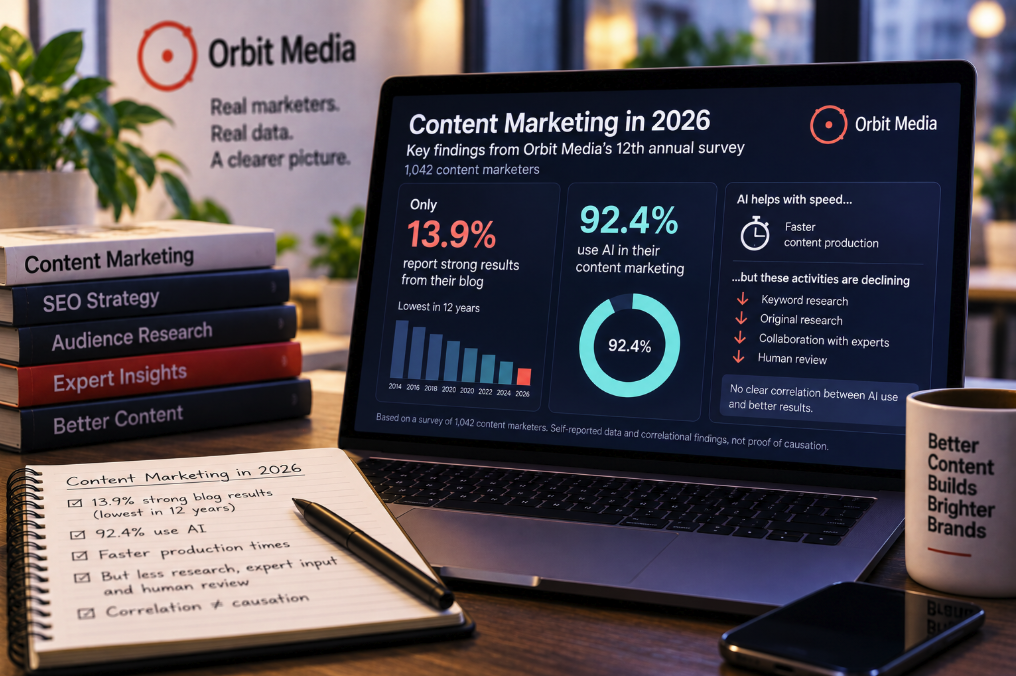
AI has become nearly universal in content marketing, but the industry's self-reported results have moved in the opposite direction. In Orbit Media's latest annual survey of 1,042 content marketers, 92.4% say they now use AI for blogging while just 13.9% report that their blogs deliver “strong results”—the lowest figure recorded across the study's 12-year history.
The contrast is provocative, but it does not establish that AI caused the decline. Orbit Media's 2026 Blogging Statistics research is based on self-reported survey data, and its comparisons between tactics and outcomes are correlational. The more useful finding is subtler: AI adoption itself does not appear to distinguish the highest-performing content programs, while several labor-intensive practices associated with stronger reported results are becoming less common.
Search Engine Land's September 10 summary highlights the same tension. Content production has become faster, yet fewer marketers report exceptional results. The question is therefore not whether marketers use AI—they overwhelmingly do—but what work they are removing as AI makes production easier.
Strong blog results fell to 13.9%
Orbit Media has run versions of its blogging survey for more than a decade. Historically, the percentage of respondents reporting strong marketing results from their blogs remained between roughly 20% and 30%. In 2026, that figure fell to 13.9%, about six percentage points below the previous low reported in the series.
Uncertainty also increased. Orbit says roughly 18% of respondents now report that they do not know whether their blog delivers results, compared with a historical range of approximately 9% to 14%. That is a measurement problem as much as a content problem. If nearly one in five practitioners cannot confidently assess performance, part of the industry's challenge may be that traditional traffic-centric metrics have become less informative as discovery fragments across search, social platforms and AI assistants.
The survey also shows declining production effort. The average article is 1,312 words, below the 2023 peak of 1,427 words, while average writing time has fallen to three hours and 20 minutes from a 2022 peak of four hours and 10 minutes. Orbit calculates that, at the average annual publishing rate, a marketer now spends about 50 fewer hours writing than in 2022.
AI is everywhere—and does not appear to provide a performance edge
AI adoption rose from virtually nothing to more than 92% in just a few years. Yet Orbit reports no meaningful performance advantage associated with AI use itself. Respondents who use AI and the small minority who do not were equally likely to report strong results. The survey also found no AI use case that clearly correlated with better overall performance.
This does not mean AI is useless. The data strongly suggests it has improved efficiency, and Orbit notes that non-AI users were more likely to report disappointing results even though they were no less likely to report strong ones. AI can help marketers brainstorm, summarize, edit, create visuals and accelerate production. What the survey challenges is the assumption that faster production automatically creates stronger marketing.
That distinction is becoming increasingly important as AI moves from novelty to baseline capability. If virtually every content team has access to similar generation and editing tools, the tool itself stops being a competitive advantage. Advantage has to come from inputs, strategy, expertise, distribution, measurement and editorial judgment—the parts of a content program that are harder for competitors to replicate with the same model subscription.
The practices associated with stronger results are declining
Orbit's most consequential observation is that many tactics correlated with stronger reported performance are being used less frequently. The list includes collaboration with experts and influencers, keyword research, original research, formal human editing, paid promotion and disciplined use of analytics. At the same time, some practices associated with weaker outcomes are becoming more common.
This pattern complicates the simple “AI killed content marketing” narrative. AI adoption coincided with lower reported performance, but it also coincided with a broader reduction in several forms of human effort. The survey cannot establish which of these changes caused the decline, whether external shifts in search and audience behavior played a larger role, or whether multiple factors interacted. It can only show that the strongest self-reported programs tend to retain practices that the wider market is abandoning.
That is a more actionable conclusion because it focuses attention on what a content team can control. AI may save an hour on drafting, but the strategic question is where that saved hour goes. If it is reinvested in interviewing an expert, analyzing proprietary data, improving visuals, checking search demand or conducting a stronger editorial review, automation may increase the total quality of the program. If it simply allows the team to publish another generic article, the efficiency gain may produce little competitive value.
Expert collaboration was the strongest predictor in the dataset
Orbit reports that collaboration with influencers and subject-matter experts was the strongest predictor of success in its 2026 dataset. Marketers using that approach were 2.6 times more likely than the overall benchmark to report strong results. Yet the practice has fallen sharply, from 25% of respondents in 2017 to just 7% today.
The logic is particularly relevant in the AI era. Expert collaboration introduces information that is difficult to reproduce through generic generation: firsthand experience, opinion, examples, disagreement, original quotations and professional judgment. It can also expand distribution because the people who contribute to an article may have their own audiences and professional networks.
None of that proves that adding an expert quote will cause a content program to outperform. High-performing organizations may simply have more resources, stronger brands or more mature editorial operations, making them both more likely to collaborate and more likely to succeed. But as a strategic signal, the correlation reinforces a broader pattern in the survey: differentiated inputs appear more valuable than production volume alone.
Keyword research is declining even as search remains important
Orbit also finds that marketers are less likely to conduct keyword research than in previous years, despite a continuing association between considering search demand and stronger results. The percentage of respondents who always research keywords has converged with the percentage who never do so, at roughly 23% each in the 2026 data.
The role of keyword research is changing, but that does not make demand research obsolete. Search increasingly includes queries performed by AI systems on behalf of users, and informational journeys can begin or end inside generative interfaces. Understanding how audiences describe their needs still helps teams choose topics, frame pages and build content around real demand rather than internal assumptions.
What has become less defensible is treating a keyword as a mechanical writing specification. Modern content strategy needs to understand the broader task behind the query: what the person is trying to decide, what evidence they need, which subquestions matter and what would make the page more useful than the sources already available. AI can assist with that research, but it cannot replace direct evidence that a market actually cares about the topic.
Original research remains scarce—and valuable
One of the clearest examples of differentiation in Orbit's data is original research. The survey says marketers who publish new research are about 50% more likely to report strong results than the overall benchmark, yet fewer content teams are producing it.
This is a revealing tension. Generative AI is extremely effective at synthesizing information that already exists, which increases the supply of competent derivative content. Original surveys, proprietary datasets, experiments and analyses do the opposite: they create facts, measurements or interpretations that were not previously available in the same form. That gives other writers, journalists and AI systems a reason to reference the source rather than another summary of the same material.
The Orbit report itself demonstrates the model. Its annual survey creates statistics that become inputs for industry discussion, news coverage and future content. The value comes not merely from writing about content marketing but from collecting evidence that other publishers do not possess.
Human editing still correlates with stronger performance
The survey also challenges the idea that AI editing can simply replace a formal editorial process. Respondents using human editors were much more likely to report strong performance, while AI-only editing was associated with weaker results in Orbit's comparisons.
Again, causality cannot be assumed. Organizations that employ editors may have larger budgets, higher standards or more mature content operations. But human review can perform tasks that are easy to undervalue when optimizing purely for speed: challenging a weak argument, identifying a missing perspective, questioning whether a statistic supports the claim, removing generic language, preserving brand voice and deciding whether an article deserves to exist at all.
AI is useful inside that workflow. It can identify inconsistencies, suggest alternatives and handle mechanical cleanup. The risk appears when the efficiency tool becomes the entire quality-control system and no accountable human remains responsible for the final argument.
Content performance is also getting harder to measure
Orbit's finding that more marketers are unsure whether their blogs work points to another industry shift. Traffic remains widely monitored, but the relationship between traffic and business value has become less straightforward. AI answers can satisfy informational queries without a click, while a buyer exposed to a brand in an AI response may later arrive through direct traffic, branded search or another channel.
That makes CRM-level outcomes increasingly important. Qualified leads, opportunities, revenue, retention and other business measures can reveal value that a simple sessions report misses. The survey finds that marketers who check analytics more consistently are more likely to report success, though the same correlation warning applies: disciplined measurement may be a characteristic of mature teams rather than the sole reason they perform better.
For content leaders, the practical implication is that measuring only organic sessions may create the impression that every content program is deteriorating even when content contributes elsewhere in the buyer journey. Conversely, declaring success based on AI citations or visibility without connecting them to meaningful outcomes can create the opposite problem. Measurement needs to evolve with discovery behavior.
The survey is a warning about what not to automate away
The most defensible interpretation of Orbit Media's 2026 survey is not that AI causes weak content. The study does not support that causal claim. Its respondents self-report both their practices and their results, and many confounding variables—from company size and industry to search changes and economic conditions—could influence the patterns.
Instead, the data suggests that AI has successfully attacked the cost of producing content while leaving the harder problem of creating distinctive, useful marketing unresolved. Ninety-two percent adoption means access to AI is no longer rare. Meanwhile, practices that require more organizational effort—expert collaboration, original research, keyword research, human editing, richer visuals, active promotion and serious measurement—continue to correlate with stronger outcomes.
That may explain why the headline numbers can coexist. Content marketers can be dramatically more efficient and still feel less successful if the industry uses that efficiency primarily to remove the work that created differentiation. Faster drafts are valuable, but a faster route to interchangeable content is not much of a competitive advantage.
The 13.9% figure should therefore be treated as a signal, not a verdict on blogging or AI. The survey cannot prove why strong results reached a 12-year low. What it does show is that nearly everyone now has AI, while relatively few marketers report exceptional performance. In a market where generation is abundant, the scarce inputs—original evidence, expert perspective, editorial judgment, audience research and disciplined strategy—may be exactly where content teams should be reinvesting the time AI gives back.