
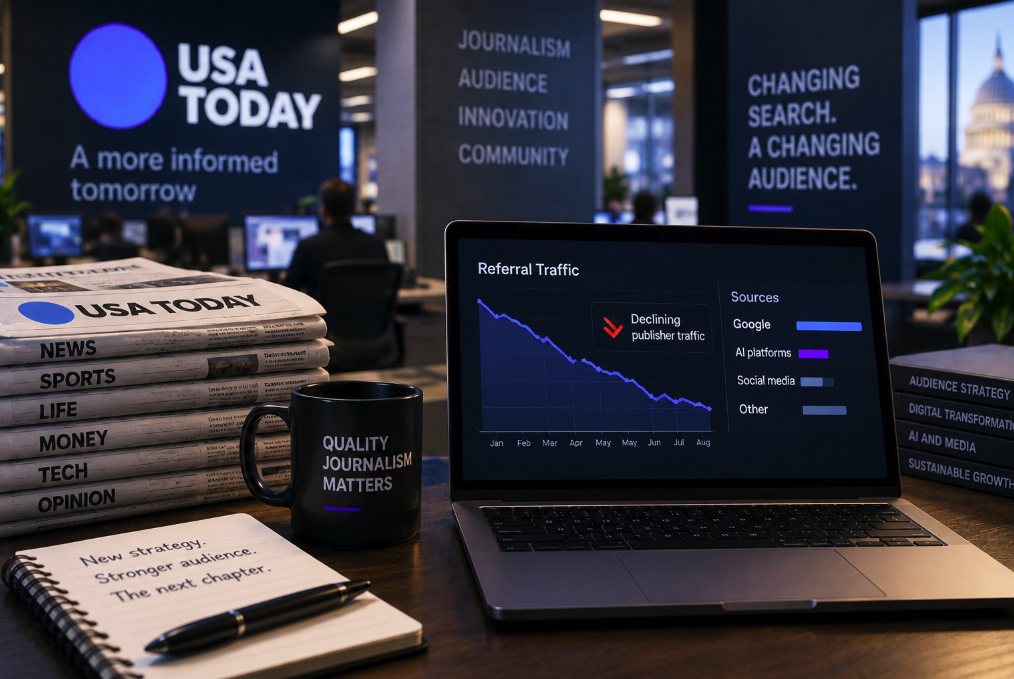
USA Today is restructuring the team responsible for growing and understanding its digital audience, cutting jobs and building a new operation around a premise that would have sounded radical for a major publisher only a few years ago: producing more stories is no longer a reliable way to produce more traffic.
The changes were detailed in an internal memo first surfaced by journalist Ben Mullin and reported on September 4 by Search Engine Land. The memo says search traffic is under pressure and that platforms increasingly keep users inside their own experiences instead of sending them back to publishers. USA Today's existing audience organization, management concluded, was built for a different media environment.
The restructuring includes layoffs, the replacement of existing audience teams with a new operation and plans for several new roles. It is therefore more than a change in SEO tactics. It is an organizational response to a distribution system in which the publisher can still create demand and influence conversations without receiving the same volume of referral traffic that once followed.
The old audience equation was built around referrals
For much of the digital publishing era, audience development had a relatively straightforward growth model. Publish more useful or timely content, optimize it for search and social distribution, win visibility on large platforms and convert that visibility into visits to the publisher's own website.
That model never worked perfectly, but the referral was economically important. Search engines and social networks provided discovery; publishers provided the destination. Pageviews then supported advertising, subscriptions, commerce and other forms of monetization.
USA Today's memo suggests that this relationship is becoming less dependable. “Growing audience by producing more content isn't as effective as it once was,” the company told staff, according to the reporting. It added that search is under pressure while platforms increasingly retain the user experience.
The language matters because it describes two changes at once. The first is declining or less predictable discovery through traditional search. The second is a broader platform shift toward answering, summarizing, entertaining or serving users without requiring them to leave.
AI search intensifies a problem publishers already understood
Generative search makes the referral problem more visible because an AI answer can consume information from multiple sources and satisfy the user before a click becomes necessary. The publisher may contribute reporting or factual material to the experience while receiving little or no direct traffic in return.
But it would be too simple to attribute USA Today's restructuring entirely to AI. The memo speaks more broadly about search pressure and platforms keeping users inside their own environments. Social networks have been moving away from outbound referrals for years, and traditional search itself has increasingly answered queries directly through rich results and other SERP features.
AI accelerates that trajectory. AI Overviews, AI Mode and standalone assistants make the platform itself a more complete destination, reducing the assumption that discovery naturally ends on a publisher page.
The result is an audience paradox: a news organization's journalism can circulate widely while its measured website audience declines.
USA Today has already been preparing for lower search dependence
The restructuring does not appear to be a sudden reaction to one bad traffic month. USA Today Co. has been telling investors for several quarters that it wants a business less dependent on any single external platform.
During its second-quarter earnings discussion, management said it was shifting attention away from anonymous, “one-and-done” visitors and toward direct, engaged and identifiable audiences. The company described those relationships as economically stronger because they can support subscriptions, advertising, commerce and repeat engagement rather than a single pageview.
USA Today Co.'s investor materials show the scale of the transition. The company reported 158 million average monthly unique visitors in the second quarter of 2026 across its U.S. and U.K. properties. Nieman Journalism Lab reported that this was down from 180 million in the first quarter, with falling traditional search referrals playing an important role in the decline.
Management has argued that lower unique-visitor counts do not necessarily mean lower demand for its journalism. Audiences may encounter USA Today content through social video, AI products and other off-platform experiences that conventional website metrics do not fully capture.
The company is prioritizing audience quality over raw volume
This is the strategic logic behind the organizational change. If large quantities of search traffic arrive once, consume one article and disappear, maximizing that traffic may become less attractive as referrals become harder to win.
USA Today Co. President Kristin Roberts told investors that direct, engaged and identifiable users provide better economics and a more reliable business than maximizing low-value anonymous traffic from one platform. The company is trying to convert reach into first-party relationships rather than treating every unique visitor as equally valuable.
That does not mean traffic has stopped mattering. Advertising still benefits from scale, subscriptions require discovery and a publisher cannot build direct relationships with people who never encounter its journalism. The change is in what happens after discovery and which channels deserve investment.
A smaller audience that returns through newsletters, apps, subscriptions or known accounts may be more valuable than a much larger audience arriving once through a generic search query.
Search remains valuable when the publisher has something distinctive
USA Today's own results also warn against declaring search dead. Management has pointed to the FIFA World Cup as an example of a category where search continued to perform exceptionally well. Company executives said USA Today Network's World Cup coverage generated 97 million pageviews, with search responsible for nearly 65% of that traffic.
That is an important counterweight to the restructuring narrative. Search pressure is not uniform across every query, topic or publisher. Breaking events, sports, local information and other areas where a newsroom has differentiated reporting can still generate enormous search demand.
The strategic question is therefore not whether to abandon SEO. It is where search remains economically productive enough to justify investment and where a publisher is merely feeding a low-value volume machine.
That distinction may increasingly shape newsroom planning. Instead of asking which topics can generate the most search visits, publishers may ask which search opportunities create durable audience relationships or meaningful revenue.
Social and video are becoming discovery channels rather than referral channels
USA Today Co. has been expanding aggressively into off-platform video. Management said the company's media properties generated around 3 billion off-platform video views during the first half of 2026, including more than one billion on TikTok.
Those numbers illustrate another reason traditional website audience metrics are becoming harder to interpret. A video viewed on TikTok can reach millions of people without producing a comparable number of visits to usatoday.com. The publisher has gained attention but not necessarily a web session.
The company is attempting to connect those environments back to owned relationships through personalized newsletters, immersive video and other products. Social media becomes the top of the funnel, but the objective is not simply to force every viewer into an article click. It is to create enough recognition and relevance that some users choose an ongoing relationship with the publisher.
That is a fundamentally different audience-development job from optimizing headlines for maximum referral volume.
USA Today is also formatting content for machines
The company is not responding to AI by trying to disappear from AI systems. It is simultaneously exploring how to make its journalism easier for machines to understand, cite and license.
In August, Digiday reported that USA Today Co. was testing content formats and templates intended to improve accessibility for AI systems. CEO Mike Reed said the company recognizes that it now has to create and format content “for humans and for machines.”
The business logic is notable. If AI platforms send fewer clicks, publishers can either attempt to block access, negotiate compensation, create direct products or find some combination of the three. USA Today is exploring several of those paths at once.
Its strategy therefore separates visibility from referral traffic. Being used or cited by an AI system may still have value if that use is licensed, builds brand recognition or contributes to a later direct relationship. The challenge is making that value measurable and monetizable.
Licensing could become an alternative to the old traffic exchange
For two decades, the implicit search bargain was content in exchange for distribution. Publishers allowed crawling and indexing because search engines returned users through links.
AI changes the economics when a platform can use publisher material to construct a useful answer while reducing the need to visit the original source. If referral value falls far enough, the old bargain becomes less attractive.
Reed has publicly said USA Today Co. could eventually consider blocking Google from scraping or linking to its content if search becomes economically unimportant enough and licensing negotiations fail. He has emphasized that the company is not at that point today and would prefer a fair licensing arrangement.
The fact that a publisher of USA Today's scale can openly contemplate that scenario shows how far the economics have shifted. Search traffic was once treated as indispensable infrastructure. It is increasingly being evaluated as one distribution channel among several, with costs and benefits that can change.
Audience teams are being redesigned around a different job
The layoffs are the human consequence of this strategic shift. Search Engine Land reports that existing audience teams are being replaced by a new operation and that USA Today plans to create several new positions as part of the restructuring.
Without the complete organizational design, it would be speculative to assign precise responsibilities to the future team. But the rationale in the memo points toward a broader definition of audience work: understanding users across platforms, strengthening direct relationships, identifying high-value engagement and adapting distribution to an environment where the click is no longer guaranteed.
Traditional audience development often sat at the intersection of SEO, homepage programming, social distribution, analytics and growth. AI search adds questions about citation visibility, licensing, machine-readable content and off-platform influence. First-party data adds another layer around identity and retention.
The job is becoming less about maximizing entrances and more about managing relationships across fragmented surfaces.
First-party data becomes more valuable as referrals weaken
USA Today Co. has also partnered with Palantir as part of an effort to better connect audience, content and first-party data. The company says the goal is to turn its enormous reach into known relationships that can support stronger engagement and monetization.
This strategy is a direct response to platform dependence. A Google visitor is partly Google's audience until the publisher creates a reason for that person to return independently. A TikTok viewer remains inside TikTok unless the relationship crosses into an owned channel. An AI user may never be visible to the publisher at all.
Email registration, subscriptions, newsletters, apps and other direct products reduce that uncertainty. They give publishers information about repeat behavior that an anonymous referral cannot provide.
As external platforms become less generous with traffic, owning the relationship becomes more valuable than merely winning the impression.
The restructuring is a warning for publishers built around search scale
USA Today is unusually large, but the underlying problem is not unique to one company. Publishers across categories are reporting weaker search referrals as Google expands AI-generated experiences and users increasingly consume information inside platforms.
The organizations most exposed are those whose economics depend heavily on large volumes of interchangeable informational traffic. If an AI answer can satisfy the query without a visit, producing another page for the same demand may no longer generate the incremental audience it once did.
Original reporting, differentiated expertise, communities, direct subscriptions and strong brands become more important because they give users a reason to seek the publisher rather than merely accept the platform's synthesis.
This does not eliminate SEO. It changes what SEO is expected to accomplish. Visibility may need to support brand demand, citations and direct relationships in addition to immediate clicks.
Traffic is becoming only one measure of audience value
The most consequential sentence in USA Today's memo may be the simplest: its current structure was built for a different media landscape. That admission captures a transition affecting the entire publishing industry.
The old structure assumed that platforms discovered content and sent users onward. The new structure has to account for platforms that increasingly complete the experience themselves. AI search makes that change explicit, but it is part of a broader movement toward closed or semi-closed distribution environments.
USA Today is responding by reducing roles, creating a new audience organization, investing in direct relationships, expanding social and video distribution, experimenting with machine-friendly content and pursuing AI licensing opportunities. None of those moves guarantees that lost search traffic can be replaced economically.
What they do show is that one of America's largest news organizations no longer believes raw referral volume can remain the organizing principle of audience growth.
For publishers, that may be the real significance of the restructuring. AI search is not simply changing where readers click. It is forcing news organizations to reconsider what an audience is when millions of people can encounter their journalism without ever arriving on their website.