
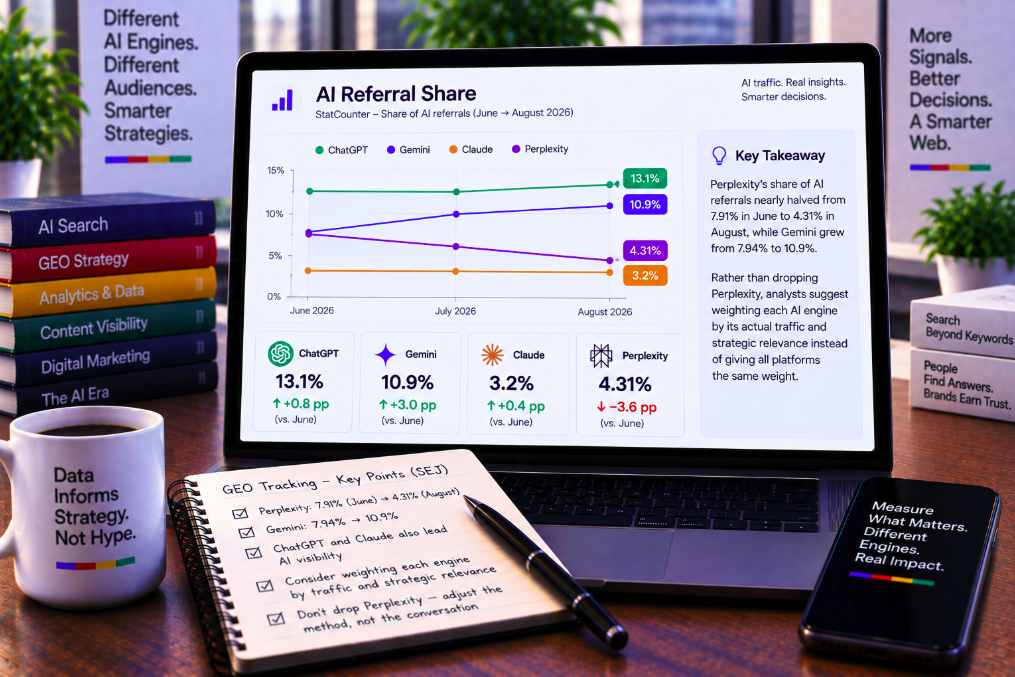
Perplexity's share of worldwide AI chatbot referrals fell sharply during the summer of 2026, adding urgency to a measurement problem that has been building across generative engine optimization: should every AI platform contribute equally to a brand's visibility score when the platforms themselves have radically different reach?
According to StatCounter's worldwide AI chatbot data, Perplexity accounted for 7.91% of AI chatbot referral share in June, almost exactly level with Gemini at 7.94%. By August, Perplexity had fallen to 4.31%, while Gemini had climbed to 10.9%.
A September 9 analysis by Search Engine Journal uses that divergence to challenge a common GEO reporting practice: averaging visibility across ChatGPT, Gemini, Claude, Perplexity and other engines as if each represents the same opportunity.
The strongest conclusion is not that Perplexity should disappear from AI trackers. It is that an unweighted average can create a misleading sense of precision. A platform responsible for a small fraction of the traffic relevant to a business should not automatically receive the same influence over a headline visibility score as the platforms where most of that business's audience actually spends time.
Perplexity fell from 7.91% to 4.31% in two months
The StatCounter trend is substantial. Perplexity lost 3.6 percentage points of worldwide AI chatbot referral share between June and August, a relative decline of roughly 45% from its June level.
Gemini moved in the opposite direction. Its share rose from 7.94% to 10.9%, a gain of almost three percentage points.
By August, StatCounter's worldwide dataset showed ChatGPT overwhelmingly ahead at 79.4%, followed by Gemini at 10.9%, Perplexity at 4.31%, Microsoft Copilot at 2.79%, Claude at 2.57% and DeepSeek at 0.02%.
Those numbers make it increasingly difficult to defend a GEO score in which a Perplexity result automatically contributes as much as a ChatGPT or Gemini result.
StatCounter is measuring referral influence, not total AI usage
The definition of the metric matters as much as the percentages.
StatCounter derives its market statistics from pageviews across websites using its analytics technology. Its long-standing methodology defines referral share by analyzing traffic that arrives at measured websites from a particular source.
That means the AI chatbot chart is especially useful for understanding the relative influence of assistants as referrers into the open web.
It should not be interpreted as a complete census of AI usage. A user can spend an hour inside ChatGPT or Gemini without clicking an external website, and that activity does not become equivalent referral evidence in StatCounter's dataset.
Referral share and assistant usage answer different questions
Search Engine Journal contrasts the StatCounter figures with Similarweb's publicly reported May 2026 web-traffic comparison of major AI assistants.
That dataset put ChatGPT at 53.9% of worldwide web visits among seven major assistants, Gemini at 27.9%, Claude at 9.2%, DeepSeek at 4.1%, Grok at 2.4%, and Perplexity and Copilot at 1.3% each.
The numbers differ dramatically because the measurement questions differ. One dataset is concerned with referral influence into websites; the other estimates visits to the AI products themselves.
Neither should be substituted mechanically for the other. A GEO team needs to decide whether it is trying to model audience exposure, outbound referral potential, competitive citations or business impact before choosing a weighting system.
The problem with equal-weight GEO scores
Consider a brand with a 40% citation rate on ChatGPT, 35% on Gemini, 30% on Claude and 90% on Perplexity. A simple average produces a visibility score of 48.75%.
The arithmetic is correct. The interpretation may be useless.
If Perplexity represents only a tiny portion of the audience or referrals that matter to the company, its exceptional 90% result pulls the aggregate upward far more than its real-world importance may justify.
The opposite problem can also occur. Weak Perplexity visibility could drag down an otherwise strong score even when the business receives almost no commercially meaningful Perplexity traffic.
A weighted score starts with audience exposure
The most obvious alternative is to weight each platform according to its share of relevant audience exposure or referral traffic.
If 70% of a company's attributable AI referrals come from ChatGPT, 20% from Gemini, 7% from Claude and 3% from Perplexity, a referral-weighted visibility index can reflect those proportions rather than assigning 25% to each engine.
This makes the aggregate score more representative of the business's observed acquisition environment.
It also creates a metric that changes as the market changes. If Gemini's contribution grows, its influence over the score increases rather than remaining frozen because the dashboard was designed when every engine was treated equally.
First-party referral data is often better than global market share
Global benchmarks are useful when a company has little internal data, but the most relevant weighting signal may already exist in its analytics.
A publisher could receive 12% of its AI referrals from Perplexity even while the platform accounts for only 4.31% of StatCounter's worldwide referral share. In that case, de-weighting Perplexity to the global average would hide a channel that matters disproportionately to that publisher.
Another business may receive less than 1% of its AI traffic from Perplexity. Giving it one-quarter of a four-engine GEO score would then be difficult to justify.
The weighting should follow the audience being measured, not a universal market-share table.
Traffic weighting alone can also fail
Claude demonstrates why a purely traffic-based formula is not sufficient.
Its consumer referral share is smaller than ChatGPT's or Gemini's, but Anthropic has built significant distribution in enterprise and professional environments. A B2B software vendor selling to developers, consultants or large corporations may care deeply about Claude even if it generates relatively little directly attributable website traffic.
A mass-market ecommerce retailer may reach the opposite conclusion.
Strategic relevance therefore needs to sit alongside observed traffic when deciding which engines deserve monitoring resources and score weight.
The same AI tracker should not serve every business model
A consumer retailer, cybersecurity vendor, travel publisher and enterprise SaaS company can all use the same generative models while facing very different discovery environments.
Retail may prioritize ChatGPT, Gemini and Google's AI search experiences because of their consumer reach. A technical B2B company may give Claude much greater weight because its customers use it in professional workflows. A publisher might prioritize whichever assistant actually sends high-quality referral traffic.
This makes a universal five-model weighting scheme conceptually weak.
The tracker should reflect the business's customers, geography, vertical and acquisition model rather than the vendor's desire to display one simple industry-wide score.
Google AI Overviews and AI Mode create a separate category
Another problem with many LLM dashboards is that they treat Google's AI Overviews and AI Mode as equivalent to standalone chatbot products.
For SEO measurement, they are not simply another assistant. They are AI layers inside the dominant search ecosystem, positioned directly within a journey that already generates enormous discovery and referral volume.
Search Engine Journal argues that Google AI search should therefore be tracked separately from ChatGPT, Gemini, Claude and Perplexity.
This prevents a Google Search exposure metric from being averaged into a generic “LLM visibility” score that obscures its fundamentally different distribution.
Gemini's rise is strategically more important than Perplexity's decline
The headline can easily become “Perplexity is losing,” but the larger market change may be Gemini's emergence as a credible second platform.
StatCounter's referral share rose to 10.9% in August. Similarweb's separate web-visit dataset had already shown Gemini gaining substantial direct usage earlier in the year.
Google also has distribution advantages that standalone assistants cannot easily reproduce, including Search, Android and its wider product ecosystem.
For GEO teams, this means Gemini can no longer be treated as a secondary checkbox included mainly for completeness.
ChatGPT remains the obvious core platform
StatCounter's August figure of 79.4% gives ChatGPT a dominant position in worldwide AI chatbot referral share.
That does not mean every brand should assign exactly 79.4% of its GEO score to ChatGPT. Global referral share is not the same thing as the brand's own audience mix.
It does mean that a dashboard giving ChatGPT and a 4.31%-share platform identical influence needs a clear business reason for doing so.
Equal weighting should be a deliberate analytical choice, not the default simply because it is easy to calculate.
Perplexity is smaller, not irrelevant
Search Engine Journal pushes back on calls to remove Perplexity entirely from LLM tracking.
That caution is sensible because emerging technology markets can change quickly. A platform can lose consumer share while developing a valuable enterprise niche, new distribution channel or distinctive role in research-oriented discovery.
Perplexity also remains structurally interesting to marketers because its answer format is heavily source-oriented and makes citations central to the user experience.
A platform does not need to be the largest consumer product to reveal useful information about which sources and competitors are winning in AI-mediated discovery.
Small platforms can provide an early-warning signal
Removing a platform from tracking eliminates both noise and information.
If Perplexity suddenly begins sending more referrals to a particular vertical, a brand that retained lightweight monitoring will see the shift before one that removed it entirely.
The same principle applies to Grok, DeepSeek and future entrants. Their current contribution may not justify equal reporting weight, but trend monitoring can identify changes in distribution before they become obvious in aggregate market data.
De-weighting preserves that option without allowing a niche engine to dominate the headline KPI.
GEO platforms should separate measurement from aggregation
The best architecture is to collect detailed data from more engines than appear in the executive score.
A measurement layer can retain citations, mentions, URLs, prompt outcomes and referral traffic for ChatGPT, Gemini, Claude, Perplexity and other relevant systems.
A separate aggregation layer can then decide which signals deserve more influence for a particular business objective.
This avoids the false choice between “track everything equally” and “stop tracking smaller engines.” Data collection can remain broad while strategic weighting remains selective.
One weighting model can combine traffic and strategic importance
A practical score does not need to rely on a single input.
Teams can start with first-party AI referral share, then adjust the platform weight for factors such as target-customer adoption, conversion quality, geographic relevance, vertical importance and growth trajectory.
A platform that sends only 3% of current referrals but is widely used by the company's enterprise buyers might receive a higher strategic weight. A platform sending 5% of low-engagement consumer traffic might receive less.
The key is to document the rule so that the score reflects an explicit business model rather than subjective dashboard tuning after results arrive.
Conversion data should eventually outrank raw traffic
Referral volume is only an intermediate outcome.
If one AI engine sends 1,000 monthly visitors who almost never convert while another sends 200 visitors who produce significantly more qualified leads or subscription starts, weighting by traffic alone can point resources in the wrong direction.
Mature GEO measurement should therefore connect assistant-level visibility to referral quality and downstream outcomes wherever attribution permits.
The ideal question is not “Which model mentions us most?” or even “Which model sends the most traffic?” It is “Which AI discovery environments create the most valuable customer behavior?”
Visibility scores should show their ingredients
Any weighted index creates another risk: a single number can hide the assumptions used to produce it.
A GEO dashboard should display the individual platform scores and the weights assigned to them alongside the aggregate result.
If the headline visibility index rises because Gemini's weight increased rather than because the brand earned more citations, the analyst should be able to see that immediately.
Transparent weighting makes the score auditable and prevents a methodology change from being mistaken for a performance change.
Market-share weighting needs regular recalibration
The Perplexity decline itself demonstrates why static weights become obsolete quickly.
In June, Perplexity and Gemini were almost tied in StatCounter's worldwide referral data. Only two months later, Gemini's share was more than two and a half times Perplexity's.
A GEO index calibrated in June and left untouched for a year would therefore describe a market that no longer exists.
Organizations using external market data should define a recalibration schedule—monthly or quarterly depending on volatility—while keeping historical score methodology available for valid trend comparisons.
Geography can change the weighting substantially
Worldwide averages can also hide country-level differences.
StatCounter's August 2026 data for Italy, for example, shows Gemini with a substantially larger share than its worldwide figure, while Perplexity also differs from the global average.
A company selling only in one market should therefore avoid weighting its GEO dashboard from worldwide data merely because the global chart is easier to obtain.
Platform relevance should be calculated as close as possible to the actual customer geography.
Prompt coverage still matters after the engines are weighted
Changing engine weights does not solve every problem with AI visibility scoring.
A tracker can correctly assign 70% of its platform weight to ChatGPT and still produce a poor metric if the prompts being tested do not represent real customer questions.
Prompt portfolios need their own weighting by search intent, funnel stage, product importance and audience frequency.
Otherwise the methodology simply replaces one equal-weighting error with another.
The better framework has three layers
Search Engine Journal recommends connecting audience exposure, visibility and business impact rather than relying on a simple assistant leaderboard.
Audience exposure asks how large or relevant each platform is for the target market. Visibility measures mentions, citations, linked URLs and prompt outcomes. Business impact connects identifiable AI referrals with engagement, leads, sales, subscriptions or other conversions.
Those layers answer different questions and should remain distinguishable even when they feed a common executive dashboard.
A brand can have excellent Perplexity visibility, modest Perplexity exposure and strong Perplexity conversion quality simultaneously. One average percentage cannot express all three facts.
The market appears to be forming tiers rather than one settled leaderboard
The current evidence supports a core group of large or strategically important assistants led by ChatGPT and Gemini, with Claude particularly relevant in enterprise contexts.
Google's AI Overviews and AI Mode belong in a separate search-discovery layer because of their integration into Google Search. Perplexity, Grok, DeepSeek and other smaller systems can then sit in an emerging or specialized monitoring tier.
That structure can change as adoption changes. It is a reporting framework, not a prediction that today's leaders will remain dominant indefinitely.
The point is to match measurement intensity and score weight to reality while retaining enough coverage to detect the next shift.
Perplexity's decline is really a warning about GEO methodology
The most important lesson from Perplexity's drop from 7.91% to 4.31% is not that marketers should delete another logo from their dashboards.
It is that the generative-search market has matured enough for equal weighting to become increasingly indefensible. ChatGPT, Gemini, Claude, Perplexity and Google's AI search products differ in audience size, referral behavior, distribution, vertical relevance and business value.
A visibility score that ignores those differences can be mathematically tidy while strategically misleading.
Perplexity should remain observable, especially for businesses where it sends meaningful referrals or exposes valuable competitive citation patterns. But it does not automatically deserve the same influence as a platform responsible for far more audience exposure. GEO measurement is moving from the question of which engines to track toward a harder question: how much should each engine matter to this specific business?