

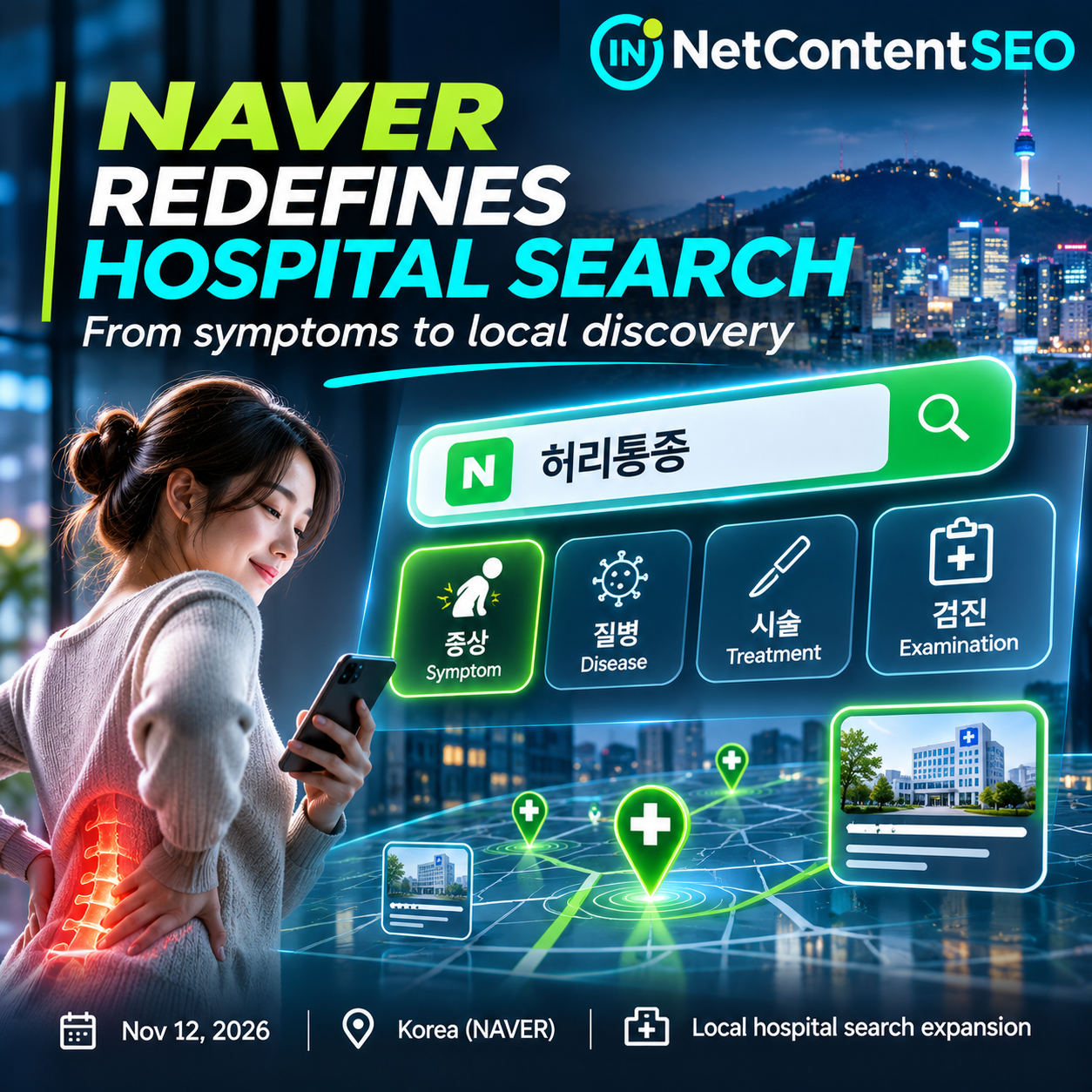

South Korea's Naver is changing how people discover hospitals: patients can search for a symptom, disease, treatment or examination instead of knowing the right medical specialty in advance. Official SmartPlace notices dated October 29 and November 13, 2026 confirm that the expanded hospital-search experience began appearing on November 12. A separate Naver Ads notice, updated November 12, says the related expansion of Place Search advertising is a test available to only some users. Those are different product claims and should not be collapsed into a universal AI rollout.
From “Which hospital treats back pain?” to relevant local providers
The Korean headline, “허리가 아픈데 어느 병원 가지? 이제 증상·질병·시술·검진명으로 병원을 찾아보세요,” translates roughly as “My back hurts—which hospital should I go to? Now search for hospitals by symptom, disease, procedure or examination.” This captures the change: Naver's local search can match the patient's expressed need to hospital service information rather than requiring a department name as the starting point.
Naver's November 13 official notice gives examples across four categories: symptoms such as headache, dizziness, shoulder pain, back pain and sore throat; diseases such as disc problems, benign paroxysmal positional vertigo and plantar fasciitis; procedures such as manual therapy, orthodontics and laser eye surgery; and examinations such as abdominal ultrasound, thyroid tests and carotid ultrasound. Users can combine those terms with an area, specialty or opening-hours intent, for example a Gangnam clinic for vertigo or a hospital for a nighttime skin complaint. These are discovery examples, not medical recommendations or diagnoses.
The verified product changes
| Feature | Before | From November 2026 |
|---|---|---|
| Hospital search vocabulary | Specialty and selected disease names | Symptoms, diseases, procedures and examinations |
| Merchant-managed clinical keywords | Up to 10 disease names | Up to 30 terms across four categories |
| Search refinement | Previous medical search filters | New treatment-area filters across integrated Search, Place, map app and desktop maps |
| Previously registered diseases | Existing entries | Migrated automatically into the disease category |
| Advertising reach | Place ads on a narrower set of queries | Expansion tested for some users and eligible queries |
The earlier October 29 SmartPlace notice introduced the new registration system. It says hospitals can select suggested standardized keywords or enter terms that the system normalizes. The November 13 notice confirms the search experience and new treatment-area filters. Changes may take time to appear in results; entering more keywords does not guarantee a higher organic ranking.
What hospital operators need to update in SmartPlace
Naver identifies a precise management path: SmartPlace → Business information → Services provided → Our hospital search keywords (업체정보 > 제공 서비스 > 우리병원 검색 키워드). Operators can register up to 30 genuine clinical terms across the four categories. Existing disease entries were carried over automatically, so they should be reviewed rather than blindly recreated.
The practical priority is to map actual services to patient vocabulary. An ear, nose and throat clinic might list dizziness as a symptom, vertigo as a disease, an eardrum procedure under treatment and a hearing test under examination—only where those services are genuinely offered. Standardized term suggestions reduce spelling and terminology mismatches, but do not remove the need for accuracy.
Naver also says automatically categorized high-frequency treated diseases, based on information from Korea's Health Insurance Review & Assessment Service, can appear on hospital detail pages. This means self-declared profile information and external healthcare records are not necessarily the same signal. Operators should not infer that adding arbitrary keywords overrides verified treatment information.
Advertising is expanding—but only as a limited test
The Naver Ads announcement, first posted November 5 and updated November 12, explicitly states that the Place Search ad change is being tested with only some users. Ads may appear on additional symptom, disease, procedure and examination searches, but not every expanded query will carry advertising.
Naver says its existing auction principles remain: placement reflects bid and business quality, and registration and billing rules have not changed. More eligible hospitals could enter a query's auction, potentially shifting ad rankings, but the notice provides no verified CPC, conversion or revenue impact figures.
There is a useful distinction between exclusions. Adding a term to SmartPlace's search exclusion keywords removes it from both organic and advertising search exposure. If an advertiser wants to preserve organic discovery while suppressing only an ad, Naver instructs them to use the ad group's negative keywords in Naver Ads. Confusing those settings could unintentionally remove valuable unpaid visibility.
Why this matters for SEO: entity attributes meet patient intent
The update illustrates a broader shift in local search: the matching problem is no longer simply “find a hospital of type X in location Y.” It becomes “find a provider whose documented capabilities correspond to the user's expressed problem.” That changes the practical SEO workflow from repeating broad specialty keywords to maintaining accurate, granular service attributes in the local business platform.
For Korean healthcare marketers, an audit should compare the clinic's real service list with the four SmartPlace categories, check location and operating-hours details, and test representative symptom-led and procedure-led queries across Naver Search and Maps. Results should be recorded by query, device, date and account context, since the rollout and advertising test may not be uniform.
Claims that a clinic will automatically rank higher after adding all 30 terms are unsupported. The official notice specifically says keyword volume does not guarantee top placement. Nor is this a Google Business Profile change; it is a Naver ecosystem update in South Korea.
Is this an AI Search launch?
Not on the evidence available. Naver's official announcements describe an expanded local search matching and filtering system, with standardized hospital keywords and public healthcare information. They do not say that a large language model directly performs the matching, nor do they establish that these results are generated by Naver's AI Briefing product.
Naver has separately developed health-focused AI Briefings that summarize medical information. But a health information summary and a local hospital finder are different search experiences. Connecting them into one confirmed generative-AI feature would overstate the evidence.
The strategic AI Search relevance is nevertheless real: the update demonstrates how a search platform can represent user intent and provider capabilities in structured categories. Such structured information could be useful in future conversational discovery systems, but that is an editorial inference—not a product integration Naver has announced.
What SEO teams outside Korea can learn
For international SEO practitioners, the transferable lesson is methodological rather than a prediction about Google's roadmap. Service-area entities, standardized terminology, structured local profiles and query-intent matching can matter more than a generic category label. A business may be relevant to a user's problem even when the user does not know the name of the professional or service needed.
For high-stakes healthcare discovery, accuracy is especially important. A listing should describe actual licensed services and available examinations, not imply medical competence through speculative keywords. Search exposure is not evidence of clinical suitability, and users should verify qualifications and seek professional advice.
A measurement framework for the rollout
To evaluate this update responsibly, analysts should build a fixed query panel covering symptoms, diseases, procedures and examinations, with variations for location and opening hours. Record whether a hospital pack appears, what filters are available, which providers are shown and whether an ad is displayed. Compare observations across devices and dates and distinguish organic exposure from the limited advertising test.
For participating clinics, track relevant Naver Business profile discovery and action metrics where available, alongside ad impressions, clicks and conversions where applicable. Do not present hypothetical gains as measured results. The official notices do not provide before-and-after traffic or conversion statistics.
FAQ
When did Naver expand hospital search?
Naver says the expanded search began appearing on November 12, 2026. SmartPlace keyword registration became available on October 29, and a November 13 notice confirmed the new search filters and examples.
How many hospital keywords can be registered?
Up to 30 terms in total, divided among symptoms, diseases, procedures and examinations, replacing the previous 10-disease-name limit.
Does registering 30 keywords guarantee better rankings?
No. Naver explicitly says that more registered keywords do not guarantee higher placement in organic results.
Is the advertising change available to everyone?
No. Naver Ads described the expanded Place Search advertising as a test shown to some users, and said ads would not necessarily appear for every expanded query.
Does this prove Naver uses an LLM to match hospitals?
No. The official product notices describe expanded search coverage and structured matching, not a confirmed LLM-powered ranking mechanism.
Conclusion
Naver's November 2026 hospital-search expansion is a concrete example of local search becoming more aligned with how people express needs. It adds practical profile-management work for healthcare providers and a new measurement challenge for local SEO teams. The strongest interpretation is not “AI now chooses your hospital,” but rather that structured service data and natural-language intent are moving closer together in local discovery. Whether this becomes part of a broader generative-AI workflow remains to be demonstrated.
Primary sources: Naver SmartPlace, October 29, 2026; Naver SmartPlace, November 13, 2026; Naver Ads, November 5 announcement updated November 12, 2026; Naver SmartPlace, March 2024 baseline. The supplied Naver Search blog post could not be directly retrieved; factual claims above are grounded in the accessible official notices. Barry Schwartz coverage: not checked.