

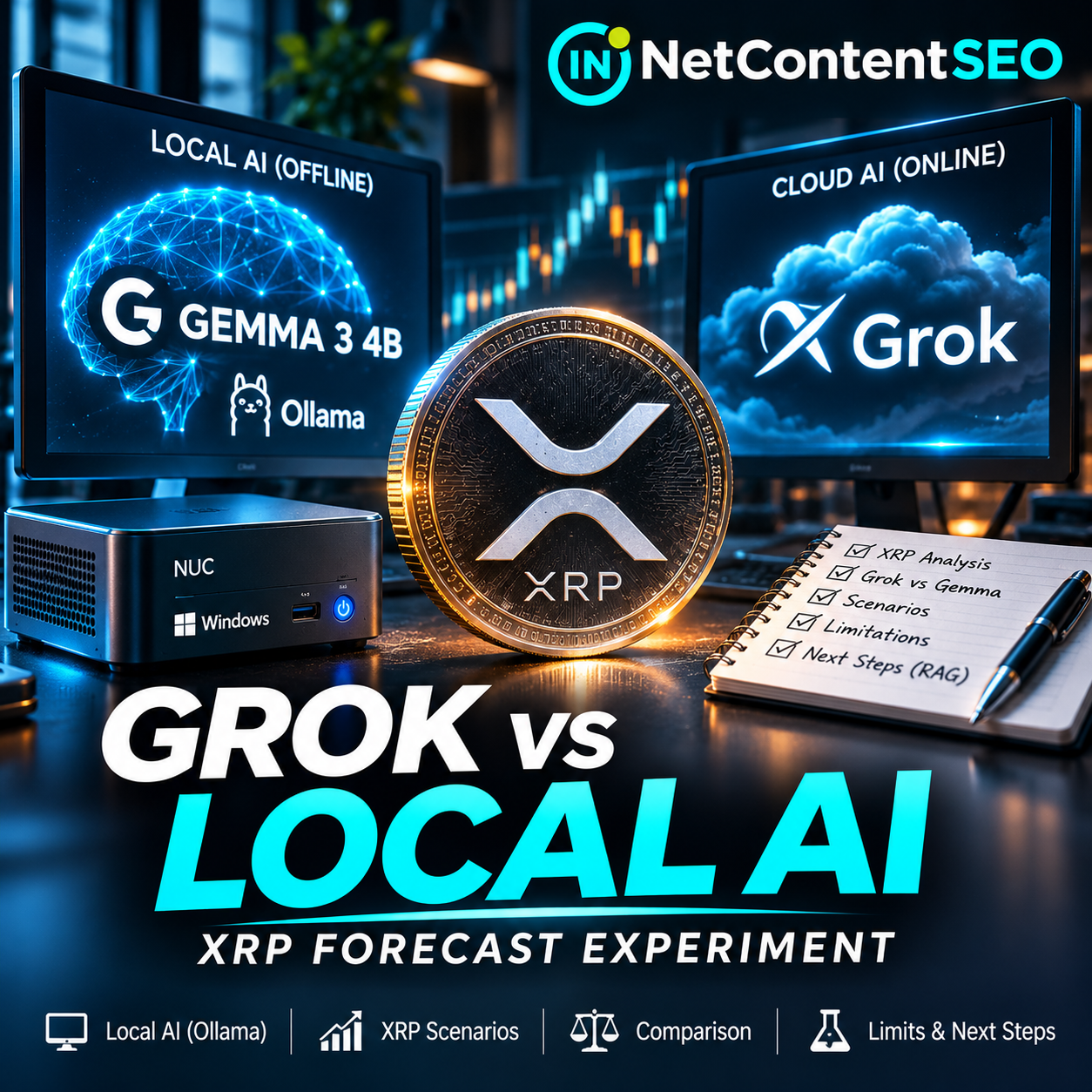

Can a small AI model running offline on an ordinary Windows mini-PC produce a meaningful cryptocurrency forecast? NetContentSEO put the question to a locally installed Gemma 3 4B model running through Ollama, then compared its XRP year-end scenarios with figures attributed to Grok in financial coverage published on November 14, 2026. The experiment is interesting not because either system has proved it can predict markets, but because it exposes what a plausible-sounding AI forecast can—and cannot—tell us.
Our experimental setup matters: Gemma was run locally on a Windows-based Intel NUC, without live market feeds, autonomous internet browsing or dedicated quantitative finance tools. Its retrieval-augmented generation (RAG) environment was only beginning to be developed; we did not establish that it retrieved any external document during this particular run. The model was given an XRP reference price of $0.96 on November 14, 2026, and asked for a December 31 forecast and scenarios. Its analysis was generated by the local model from that prompt and its pretrained knowledge, rather than fetched from a live financial research service. This does not mean it reasoned from zero or that its assumptions were independently verified.
The two AI forecasts, side by side
In a November 14 report by Sam Daodu at 24/7 Wall St., also carried by Yahoo Finance, Grok was reported as assigning a 35% chance to XRP touching $0.80 before year-end. Separately, the report attributed three possible December 31 closing-price scenarios to Grok: $0.82 bearish (30%), $1.05 base (50%) and $1.40 bullish (20%). The sum of the latter two probabilities produces the article's quoted 70% chance of a year-end close above $1. The 35% intraperiod-low estimate is a different event and should not be conflated with the closing-price distribution.
Our local Gemma 3 4B output gave a point estimate of $0.75, with bearish, base and bullish scenarios of $0.60, $0.85 and $1.05 respectively. It did not provide calibrated probabilities for those three scenarios. The following figures are model outputs, not observed market outcomes or independently validated targets.
| December 31, 2026 scenario | Grok, as reported | Local Gemma 3 4B |
|---|---|---|
| Bearish | $0.82 | $0.60 |
| Base | $1.05 | $0.85 |
| Bullish | $1.40 | $1.05 |
| Additional prediction | 35% chance of touching $0.80 before year-end | $0.75 point forecast |
XRP year-end scenarios: reported Grok vs offline Gemma
Illustrative comparison of quoted forecast values; the prompts and underlying methods were not matched or audited.
Why the offline result is worth examining
A four-billion-parameter model running locally can produce a structured narrative: macroeconomic conditions, institutional adoption, competition, regulation and possible bearish or bullish paths. In the captured run, the interface reported approximately 10.94 generated tokens per second. This is an observation from one local output, not a hardware benchmark under controlled conditions.
Gemma's central case of $0.85 is approximately 19% below Grok's reported $1.05 base case. Its bullish $1.05 is identical to Grok's base figure. That numerical proximity is intriguing but does not establish shared methodology, predictive ability or independence from information learned during pretraining. We cannot establish whether either system used overlapping public narratives, and the exact Grok prompt, runtime configuration and full raw response were not available for an apples-to-apples reproduction.
Nor does local execution mean the model has learned live market conditions. Its weights encode patterns from pretraining, and the user-supplied $0.96 reference price anchors the response. RAG, when configured, retrieves documents at inference time; it does not automatically retrain the model or guarantee accurate answers. In this experiment, there was no verified live-data grounding.
Where Gemma got important things wrong
The output also demonstrates why fluent forecasts need an audit. First, Gemma gave a $0.75 numerical point forecast while calling $0.85 its base scenario, without explaining whether the former was an expected value, median, or subjective adjustment. Without scenario probabilities, no coherent expected value can be calculated from the three cases.
Second, it described the December 31, 2026 horizon as extending over the 'next 7 years.' From November 15, 2026, year-end is only 46 days away. That is a straightforward temporal error.
Third, Gemma's bearish and bullish narratives repeatedly referenced ongoing XRP legal uncertainty or a future positive resolution of its SEC dispute. The US Securities and Exchange Commission announced on August 7, 2025 that it and Ripple had dismissed their appeals, resolving that civil enforcement action, while leaving the district court's final judgment, including the penalty and injunction, in effect. Broad regulatory risk may persist, but presenting that particular litigation as still awaiting resolution is outdated.
Fourth, Gemma invoked a vaguely described 'XRP Bridge' scaling solution and the risk of its breakdown. The response did not identify a documented product, technical specification or source supporting that claim. It should not be repeated as a verified property of the XRP Ledger.
Finally, Gemma suggested the Federal Reserve might continue to raise rates selectively and attached strong causal narratives to regulation, macroeconomic conditions and adoption. Those are hypothetical assumptions, not verified descriptions of November 2026 policy or evidence of future market movements.
Grok's reported percentages need scrutiny too
Grok's reported 35%, 30%, 50% and 20% numbers look precise. But the article does not establish that the probabilities came from a statistically calibrated forecasting system, a disclosed quantitative model or out-of-sample tests. A chatbot can assign numbers to scenarios without demonstrating that events assigned a 35% probability actually occur approximately 35% of the time across a large sample.
The reporting also shows why predictions are time-dependent. On November 5, another 24/7 Wall St. comparison attributed a $1.45 year-end prediction to Grok, based on a reference XRP price of $1.26. Nine days later, the reported Grok base scenario was $1.05, from a $0.96 reference. That is not automatically a contradiction: market conditions and prompts can change. It does mean forecasts must be stored with timestamps and input conditions rather than treated as durable investment facts.
What the comparison does—and does not—prove
It proves that a locally deployed small model can generate a structured scenario analysis from a supplied price and general background knowledge. It also shows that an offline model can produce factual and logical errors while sounding confident. It does not prove that Gemma forecasts markets as well as Grok, that the two systems have comparable data access, or that either forecast is actionable.
In particular, this is a single-run, non-controlled exploratory comparison. We have not reproduced the original Grok session, standardized the prompts, measured random-seed variation, evaluated a long forecast history or tested the accuracy of either system against the December 31 close. There is no winning model yet.
Next experiment: connect verified data, then measure the difference
NetContentSEO's planned next step is to develop the local Ollama setup into a reproducible research workflow, without migrating the existing production infrastructure. A future system could ingest timestamped market prices and volumes from documented APIs, retrieve official regulatory updates, archive prompts and outputs, and clearly separate retrieved evidence from model interpretation.
For each forecast, we would record the model name and version, inference settings, prompt, price snapshot, source timestamps, output scenarios, assumptions and subsequent actual closing prices. We would compare an offline baseline with a data-grounded version of the same local model, ideally using multiple prompts and repeated trials. Relevant measures would include forecast error, scenario coverage, factual-error rates and the proportion of statements backed by retrievable sources. One correct guess would not count as proof of skill.
It is also important to keep the research environment distinct from trading infrastructure. This experiment does not require private portfolio data, trading credentials, automated orders or any financial transaction.
Frequently asked questions
Did Gemma 3 4B generate its XRP analysis independently?
It generated the text locally through Ollama, using the provided $0.96 reference price and pretrained knowledge. It did not autonomously consult live market feeds. That is independent local inference, not an independently verified financial forecast.
Was the local RAG system already trained on XRP data?
No such claim can be supported by this experiment. The RAG environment was in an early stage, and no retrieved financial sources were demonstrated in the captured run. RAG retrieves information; it does not by itself update the model's trained weights.
Which model predicted a higher XRP price?
In the compared base scenarios, Grok's reported figure was $1.05 and Gemma's was $0.85. They were generated under different, incompletely documented conditions.
Is Grok's 35% chance of XRP hitting $0.80 reliable?
The percentage is attributed to Grok by the source article. Without published calibration and reproducible methodology, it should not be treated as an empirically validated probability.
Can a local AI model forecast crypto without internet?
It can produce hypothetical scenarios based on a supplied price and pretrained patterns. Without current evidence, systematic validation and error measurement, it cannot establish that those scenarios are reliable predictions.
The takeaway
The most surprising part of this experiment is not that Gemma's numbers resemble Grok's. It is how quickly a modest offline system can produce the appearance of a professional forecast—and how much careful verification is still needed to distinguish useful reasoning from plausible fabrication. The future of local AI research is not about trusting its answers more. It is about making every answer easier to test.
Sources and disclosures: 24/7 Wall St., November 14, 2026; Yahoo Finance syndication; 24/7 Wall St., November 5 comparison; SEC litigation release, August 7, 2025. Gemma figures and local setup are from NetContentSEO's supplied experiment transcript, not independently reproduced by a third party. No portfolio holdings or personal investment data were used in this article. This is a research exercise, not financial advice.