
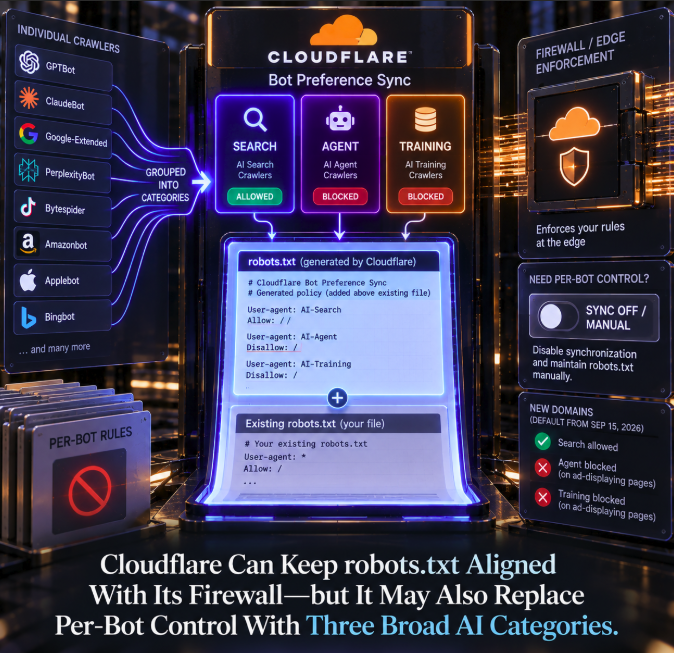
Cloudflare is trying to solve a deceptively common AI-crawler problem: a website's robots.txt says one thing while its actual firewall rules do something else. Bot Preference Sync is designed to keep those two layers aligned by translating the site's Cloudflare AI-bot preferences into directives that Cloudflare can serve in robots.txt. The convenience comes with an important constraint, however. The synchronization operates around broad behavioral categories rather than a custom policy for every individual crawler.
A detailed Search Engine Journal analysis published September 18 examines that trade-off. Cloudflare's newer AI controls divide bots into three functional groups — Search, Agent and Training — and Bot Preference Sync can derive the public crawler instructions from those settings. For sites whose policy fits those categories, this can eliminate configuration drift. For publishers that deliberately allow one company's training crawler while blocking another, the abstraction may be too coarse.
The problem Cloudflare is solving is real
robots.txt and edge enforcement are separate systems. A publisher can update a Cloudflare security setting today while leaving crawler directives written months earlier untouched. The result can be a public policy file that welcomes a crawler the firewall rejects, or tells a bot to stay away while the edge continues to serve it normally.
That inconsistency is operationally easy to create because the two controls are maintained in different places. Cloudflare's sync concept makes the dashboard policy the source from which the public robots.txt instructions are derived, reducing the chance that an old file silently stops representing what the site owner intends.
The distinction between preference and enforcement remains essential. Cloudflare's official managed robots.txt documentation explicitly notes that compliance with robots.txt is voluntary. The file expresses a site's preference; it does not technically prevent a crawler from connecting. Cloudflare recommends AI Crawl Control when a site wants actual blocking at the network edge and says the two mechanisms can be used together.
Cloudflare can prepend its policy to the site's existing robots.txt
Cloudflare has supported managed robots.txt behavior for some time. Its bot changelog records that since July 2025, managed directives can be prepended to an existing robots.txt file rather than simply replacing the publisher's file. The Bot Preference Sync model builds on the same basic idea: Cloudflare-generated policy is served before the site's existing content, allowing the original file to remain present underneath.
The Search Engine Journal analysis describes the synchronized section as being enclosed by Cloudflare Bot Preference Sync markers. This makes the origin of the generated portion visible and preserves the manually maintained content below it. The practical effect is that Cloudflare can keep its AI policy reflected in the public file without requiring the site owner to manually edit the file every time a dashboard preference changes.
That sounds like straightforward configuration hygiene, and for many sites it may be exactly that. The complication begins when a publisher's real policy cannot be described by Cloudflare's three categories.
Search, Agent and Training are behavior classes, not individual crawler rules
Cloudflare changed its AI traffic controls in July 2026 so customers could manage crawlers by behavior instead of relying on one universal “Block AI bots” switch. Its bot solutions changelog identifies the three groups as Search, Agent and Training. Cloudflare's API likewise exposes separate ai_search, ai_user and ai_training policy fields, together with a bot_preference_sync_enabled setting that allows Cloudflare to serve robots.txt content derived from those preferences.
This is much more expressive than a single all-or-nothing AI crawler switch, but it is not equivalent to a hand-written bot list. A publisher may consider two crawlers to be “Training” bots while making different business decisions about them. One could be allowed because the publisher believes the relationship provides useful downstream discovery, while another is blocked because the publisher sees no corresponding value.
A category-level setting cannot represent that distinction if both crawlers belong to the same Cloudflare classification. According to the Search Engine Journal analysis, the route for sites that require this level of granularity is to turn synchronization off and maintain their crawler instructions manually.
Automation can therefore change who controls the policy language
This is the deeper issue behind the feature. When a site writes robots.txt manually, the publisher decides which user agents are named and what each is allowed to access. When Bot Preference Sync generates the policy, Cloudflare's crawler classification system becomes part of that decision. Cloudflare determines which tracked bot belongs to Search, Agent or Training, while the publisher chooses a policy for the category.
For a simple rule such as “allow AI search but disallow model training,” this abstraction is useful. It reduces maintenance and can automatically account for crawlers Cloudflare adds to its tracked list. The publisher no longer has to keep discovering new user-agent names and updating the file individually.
For a selective policy — allow GPTBot, block another training bot, permit one agent but reject another — the abstraction can remove information the publisher considers important. The policy is easier to maintain precisely because it is less granular.
The new-domain defaults make understanding the categories more important
Cloudflare's official changelog says that from September 15, 2026, new domains receive new AI-traffic defaults: Training and Agent are blocked on pages that display ads, while Search remains allowed. These defaults apply to the behavior-based AI controls and reflect Cloudflare's effort to distinguish discovery from agent activity and model training rather than treating every AI crawler identically.
The Search Engine Journal analysis reports that Bot Preference Sync is intended to be enabled by default for new customers as part of the announced product behavior. That makes the feature especially important for administrators who accept onboarding defaults without later inspecting the generated robots.txt. A dashboard choice can become a public crawler-policy statement even if nobody on the SEO or engineering team manually edited the file.
Defaults are not inherently problematic, but they deserve review when they encode a business decision. Whether a site wants AI systems to search, act on behalf of users or train on its content is not purely a technical configuration. Different publishers can reasonably choose different answers.
Cloudflare's categories also expose the mixed-use crawler problem
Classifying AI bots is not always clean because some crawler operators support multiple product functions. A company can operate search, AI-answer generation and model-development systems within the same broader ecosystem. Cloudflare's approach attempts to classify behavior and has published expectations around transparency and control for crawlers that span search and training.
This matters because a publisher may want conventional search visibility while declining certain forms of AI use. The ideal control is not simply “Google allowed” or “Google blocked,” but a policy that distinguishes what the fetched content may support. The industry's crawler vocabulary and robots conventions were not originally designed for that level of product-specific licensing intent.
Cloudflare's category model is one attempt to make that complexity manageable. Its limitation is the same as its strength: it standardizes many individual bots into a small number of choices.
robots.txt still does not enforce the decision
Whatever Bot Preference Sync writes, the generated file remains a crawler instruction rather than a network access control. A cooperative crawler reads the rule and follows it. A crawler that ignores the file can still request the content unless another technical layer blocks the request.
That is why alignment with Cloudflare's edge settings is valuable. If the publisher's intent is to prohibit access rather than merely communicate a preference, firewall or AI Crawl Control rules can enforce the decision while robots.txt documents it. The two layers serve different functions even when they express the same policy.
Keeping them synchronized also makes auditing easier. A technical team can compare what the site publicly asks crawlers to do with what Cloudflare actually allows at the edge. A contradiction between those layers becomes visible rather than remaining an accidental artifact of an old file.
Sites with bespoke AI policies should audit before enabling sync
The practical test is straightforward: compare the current robots.txt with the AI bot settings in Cloudflare and ask whether the three categories reproduce the intended policy. Sites with a broad “allow search, block training” strategy may find that Bot Preference Sync removes manual maintenance without materially changing their position.
Sites with per-company agreements, licensing relationships or deliberate crawler exceptions should inspect more carefully. If the current file contains individual rules for GPTBot, ClaudeBot, Google-Extended, PerplexityBot, Bytespider, Amazonbot or other agents, collapsing those choices into categories can change the policy's meaning even when the generated file is technically valid.
The audit should also extend beyond the file itself. Teams should check the corresponding edge rules, document which layer is intended to express preference versus enforce access, and monitor changes to Cloudflare's bot classifications. If the site's policy depends on the identity of an individual crawler, a classification maintained by a third party becomes a dependency worth tracking.
Bot Preference Sync is a maintenance tool, not a universal crawler policy
Cloudflare's idea addresses a genuine weakness in modern AI crawler management. Websites increasingly have several overlapping policy surfaces — robots.txt, CDN settings, WAF rules, crawler dashboards and emerging licensing controls — and configuration drift between them is almost inevitable. Automatically keeping two of those layers aligned can reduce mistakes.
But synchronization only works cleanly when the source policy is expressive enough. Search, Agent and Training are useful operational categories, not a substitute for every publisher's business logic. The more differentiated the site's relationships with AI companies become, the more likely a three-category policy is to lose information.
Cloudflare can make robots.txt more consistent with the firewall, but consistency and granularity are different goals. Publishers that are comfortable making one decision for an entire AI behavior class can gain useful automation. Publishers that want to negotiate crawler access one company at a time may still need the oldest tool in the stack: a carefully maintained file they control themselves.